mudras

Mudras: The Real History of Yoga’s Sacred Gestures

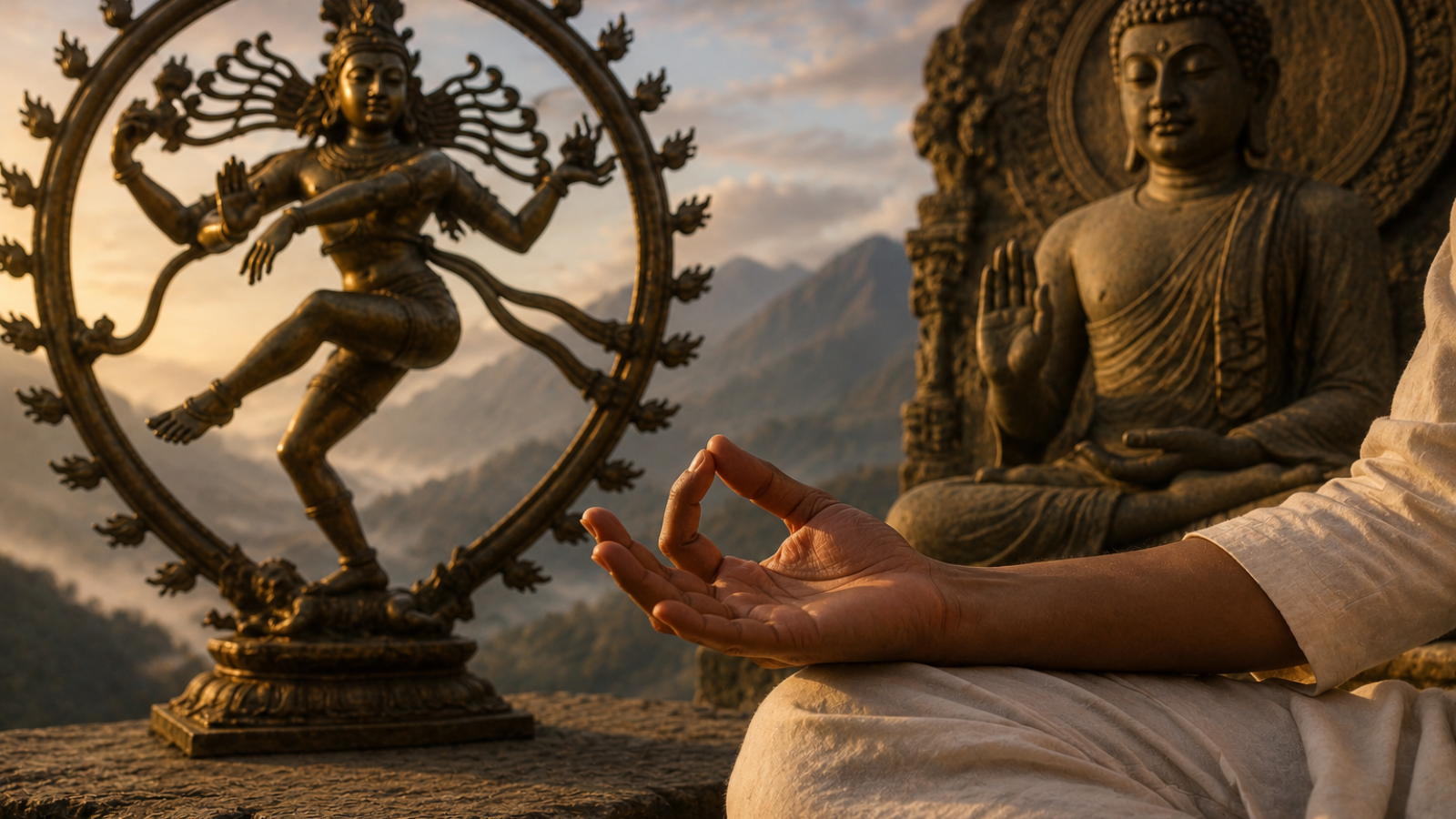
There is a bronze Shiva in the Metropolitan Museum, cast in south India around the eleventh century, dancing inside a ring of fire. He has four arms. Each hand is doing something specific. The upper right holds a small drum, marking the beat of creation. The upper left holds fire, which destroys. The lower right is raised, palm outward, fingers up. The lower left points down and across toward a raised foot.

Nothing here is decorative. The raised palm means do not be afraid. The pointing hand indicates the foot, which means refuge. A sculptor in the eleventh century encoded a complete theological statement in the position of four hands, and any literate viewer could read it. That is what a mudra is before it is a yoga technique.

The Word

Mudra means seal, mark or stamp. The same root gives words for a signet ring and for the impression it leaves in wax. The sense is worth holding onto. A seal closes something, and it also authenticates. Both meanings run through how the term is used.

The word covers several distinct things, and confusing them causes most of the muddle in modern writing. There are iconographic mudras, the hand positions of deities in sculpture and painting. There are ritual mudras, gestures performed by priests during ceremony. There are dance mudras, the hasta vocabulary of classical Indian dance. And there are hatha yoga mudras, which are mostly not hand gestures at all.

The Hand Positions People Know

The iconographic vocabulary is the oldest and the most widely legible, and it developed in both Hindu and Buddhist art.

Abhaya mudra, the raised open palm, means fearlessness or protection. It is a gesture of reassurance, and it works because it shows an empty hand.

Varada mudra, the downturned open palm, means giving or granting a boon.

Dhyana mudra, both hands resting in the lap, one on the other, palms up, is the meditation posture seen on countless Buddha figures.

Bhumisparsha mudra, the earth-touching gesture, refers to a specific moment: the Buddha, challenged as to his right to enlightenment, touched the ground and called the earth to witness.

Dharmachakra mudra, both hands at the chest with thumbs and index fingers touching, indicates the turning of the wheel of teaching.

Jnana or chin mudra, thumb and index finger joined, is the one modern practitioners use most. The joined fingers are commonly read as the individual self meeting the universal.

These are a language. Anyone raised around the art could read a statue the way a European could read a saint’s attributes.

What Hatha Texts Mean by Mudra

Here is where modern writing usually goes wrong.

The Hatha Yoga Pradipika, compiled around 1450, devotes its third chapter to mudras and lists ten. Almost none of them involve the hands. Maha mudra is a seated posture with a heel pressed into the perineum. Viparita karani is an inversion. Khechari mudra involves turning the tongue back into the nasal cavity. Vajroli, sahajoli and amaroli concern control of the urogenital system.

The bandhas are grouped with them: mula bandha at the pelvic floor, uddiyana bandha drawing the abdomen up and back, jalandhara bandha at the throat. These are whole-body techniques, and the seal metaphor is literal. They are meant to close a channel and prevent energy from escaping downward, so that it can be driven upward instead. The Gheranda Samhita, from around 1650 to 1700, lists twenty-five, and adds a handful of genuine hand gestures. But the centre of gravity remains firmly in the body rather than the hands.

So the Pradipika’s mudras and the mudras taught in a modern class share a name and very little else.

What the Texts Claim

Hatha sources make extravagant promises for these practices, and it is worth being straightforward about them. Khechari is said to defeat hunger, thirst, disease and death. Vajroli is said to grant powers to a practitioner who has mastered it. Maha mudra is said to destroy the effects of all bad actions.

Nobody should take these as clinical claims, and the texts themselves are working within a religious framework where liberation, not health, is the aim. The practices also carry real risk. Khechari in its full form involves cutting tissue over months. Vajroli has been the subject of considerable scholarly discomfort. The texts insist on a qualified teacher and describe these as secret.

This article describes what the tradition contains. It is not instruction, and none of these should be attempted from a written description.

The Hand Gestures in Modern Practice

Modern yoga classes use a small set of hand mudras, usually seated, usually alongside breathing or meditation.

Chin mudra and jnana mudra, thumb to index finger, palms down or up. Anjali mudra, palms together at the chest, which functions as a greeting and a gesture of respect. Occasionally shuni, prithvi or others drawn from later compilations. Claims are frequently attached: that particular finger contacts balance particular elements, or affect particular organs, or influence specific mental states.

Those correspondences come mainly from later tantric and ayurvedic compilations, and from twentieth-century systematisations. They are not in the early hatha texts, and no clinical evidence supports the specific physiological claims. What can be said without overreaching is that a deliberate, sustained hand position provides a physical anchor for attention. That is not a small thing in a meditation practice, and it does not require any additional mechanism to be useful.

Dance, Which Kept the Vocabulary Alive

There is a fourth stream, and it preserved more of the gestural language than the yoga tradition did. Classical Indian dance uses an extensive vocabulary of hand positions called hasta or hasta mudra. The Natya Shastra, a treatise on performance compiled somewhere between 200 BCE and 200 CE, catalogues them, and later texts expand the list considerably.

These are functional rather than symbolic in the loose sense. A dancer uses them to name specific things: a deer, a lotus, a bee, a conversation, a refusal. An audience trained in the form reads them as narrative. Bharatanatyam, Kathakali, Odissi and other traditions still teach the vocabulary today, which means the gestures on an eleventh-century bronze remain legible to people who have never studied art history.

Reading the Statue

Which brings the subject back to where it started. A gesture that means something to a viewer, held deliberately by a practitioner, sitting inside a tradition that has used the vocabulary for two thousand years, is doing something real. It is not pharmacology. It is language.

The bronze Shiva has been holding that raised palm since the eleventh century. Do not be afraid. Somebody meant it, and put it in metal so that it would keep meaning it.

Mudras: Reader Questions

What does mudra mean?

Seal, mark or stamp in Sanskrit, from the same root as words for a signet ring and its impression. The sense of closing and of authenticating both apply.

What is chin mudra?

The gesture of joining thumb and index finger, commonly used in seated practice and usually interpreted as the individual self meeting the universal.

Are hatha yoga mudras hand gestures?

Mostly not. The Hatha Yoga Pradipika lists ten mudras, and almost all are whole-body techniques involving posture, locks and internal control.

What is abhaya mudra?

The raised open palm, meaning fearlessness or protection. It is among the most widely used gestures in Hindu and Buddhist art.

Do mudras have proven health effects?

The specific physiological correspondences taught in modern classes come from later compilations and twentieth-century sources. No clinical evidence supports them.

What is bhumisparsha mudra?

The earth-touching gesture, referring to the moment the Buddha called the earth to witness his right to enlightenment.

Sources consulted: Svatmarama, Hatha Yoga Pradipika, Brian Dana Akers translation; Gheranda Samhita, James Mallinson translation; James Mallinson and Mark Singleton, Roots of Yoga (2017); The Metropolitan Museum of Art, South and Southeast Asian Art department.

Joy Aditya Avatar
Pranayama

Pranayama: The History of Yogic Breathing

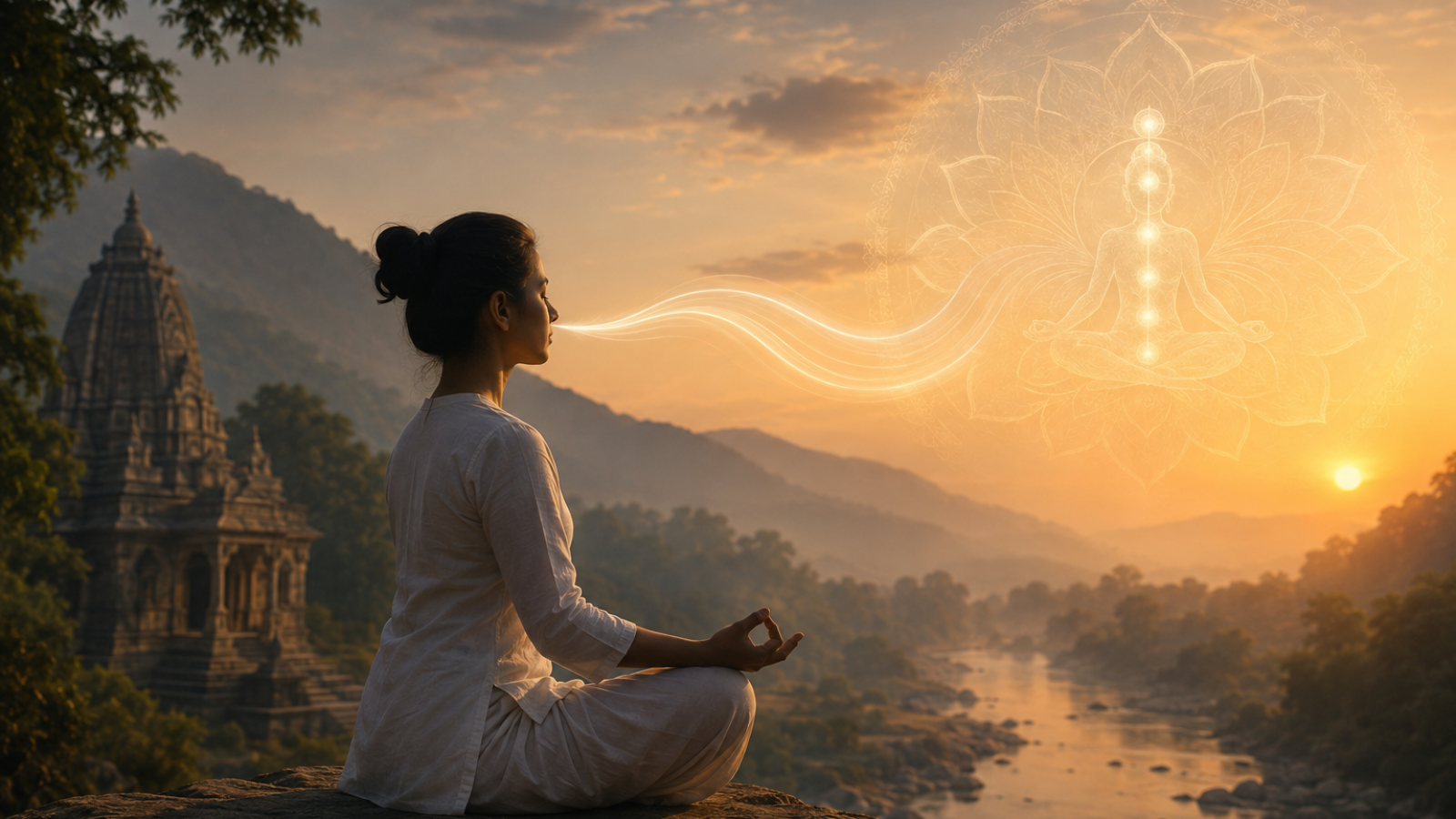
Breath is the only autonomic function a person can take over voluntarily. The heart cannot be stopped by deciding to stop it. Digestion continues regardless. But breathing runs on its own until the moment you attend to it, and then it is yours. Indian traditions noticed this very early and built a great deal on it.

The Word

Pranayama is a compound, and the way you break it determines what it means. Prana means breath, and also life force, vital energy, the animating principle. The Upanishads use it in both senses without apology. The second half can be read as ayama, extension or expansion, or as yama, restraint or control.

So pranayama is either the extension of the life force or the restraint of the breath, depending on which reading you take, and the tradition has used both. Classical texts lean toward restraint. Modern teaching often prefers extension. Neither is wrong. It is worth knowing that the ambiguity is in the Sanskrit and not in the translation.

Before It Was a Technique

The Vedas revere breath without systematising it. Prana appears throughout the Upanishads as the vital principle, and several passages stage a competition among the faculties: speech, sight, hearing and mind each leave the body in turn, and the body survives each departure diminished. Then breath prepares to leave, and everything else immediately concedes.

There is also a practical matter that receives less attention than it deserves. Vedic chanting demanded precise breath control, because long metrical passages had to be delivered on single controlled exhalations with exact pitch and timing. A priest doing that for years is doing something structurally close to breath training, whatever he called it.

Patanjali’s Version

Patanjali gives pranayama the fourth limb, in sutras 2.49 to 2.53, and his treatment is brief and specific. He defines it as the cessation of the movement of inhalation and exhalation, arising once posture is established. Three movements follow: external, internal, and held still. Each is regulated by place, time and number. With practice they become long and subtle.

Then he names a fourth kind, which transcends the internal and external, arising without deliberate regulation. The result, he says in 2.52, is that the covering over the inner light thins. And in 2.53, the mind becomes fit for concentration. That is the whole classical account. Five sutras. No named techniques, no ratios, no alternate nostrils. The techniques with names arrive later.

What Hatha Added

Hatha texts treat pranayama as central, and considerably more dangerous than Patanjali suggests. The Hatha Yoga Pradipika, compiled around 1450, devotes its second chapter to it and introduces the vocabulary most practitioners now use.

Kumbhaka, retention, is the operative element. Inhalation and exhalation are described as preparation for the pause between them.

Named practices appear:

  • Nadi shodhana, channel purification, alternating nostrils
  • Ujjayi, the victorious breath, with a constricted throat
  • Bhastrika, bellows breath, forceful and rapid
  • Kapalabhati, skull-shining, forceful exhalation
  • Sitali and Sitkari, cooling breaths drawn over the tongue
  • Bhramari, the humming bee breath

The purpose is explicitly energetic rather than calming. Breath is being used to clear the nadis and to move kundalini through the central channel, and pranayama is the primary tool for it.

The Pradipika also insists on caution. Practised correctly, it says, breath control removes disease. Practised wrongly, it produces illness, and it compares the practitioner to somebody taming a lion, tiger or elephant: gradually, or not at all.

The Modern Layer

Two things happened in the twentieth century. Krishnamacharya, teaching at Mysore from 1926 to 1946, integrated pranayama with posture and with individual instruction, and his students carried different versions of it worldwide. B.K.S. Iyengar’s Light on Pranayama, published in 1981, is the most detailed modern manual in English.

Then research interest arrived. Slow breathing, at roughly six breaths a minute, has been studied for its effects on heart rate variability and blood pressure. Extended exhalation is linked to parasympathetic activation. Trials exist on breathing interventions for anxiety, hypertension and asthma.

The literature is genuinely mixed. Sample sizes are often small, controls are difficult, and the effect sizes vary considerably between studies. Some findings replicate and some do not. What can be said reasonably is that deliberate slow breathing measurably affects the autonomic nervous system. What cannot be said reasonably is that this validates the classical framework, which was describing something else entirely.

What the Ratios Are

Modern teaching frequently specifies numerical ratios, and their origin is worth knowing. The most commonly cited is 1:4:2. Inhale for a count, hold for four, exhale for two. Variants appear across hatha and later texts, and the Hatha Yoga Pradipika discusses graduated counts. What the classical sources do not do is present one ratio as universal. Counts vary between texts, and they are given as part of a supervised progression rather than as a fixed prescription.

The certainty with which specific ratios are now taught is largely a twentieth-century development.

Two Different Projects

The gap is worth naming clearly. A medieval hatha practitioner performing kumbhaka was attempting to force energy into a central channel in order to reach liberation. A modern student practising extended exhalation before bed is attempting to fall asleep. Both are doing breath work. They are not doing the same thing, and the physiological research bears on the second far more than the first.

That said, this article describes practices rather than teaching them. Forceful techniques such as bhastrika and kapalabhati, and extended retention, are not suitable for everybody, and the classical texts themselves insist on a qualified teacher. Anyone with cardiovascular or respiratory conditions, or who is pregnant, should take medical advice first.

Why It Persists

Of everything in the yogic toolkit, pranayama has travelled furthest with the least modification. Postures have been rebuilt almost entirely. The philosophy is frequently discarded. The goal has been quietly swapped from liberation to wellbeing. But breath practice is broadly the same activity now as it was in 1450, because breath is the same and bodies are the same, and the thing being manipulated has not changed. Which is, when you consider it, an unusual kind of continuity.

Pranayama: Common Questions

What does pranayama mean?

A compound of prana, breath or life force, with either ayama, extension, or yama, restraint. Both readings appear in the tradition.

What does Patanjali say about pranayama?

He treats it in five sutras, 2.49 to 2.53, defining it as the regulation of inhalation and exhalation and stating that it thins the covering over inner light and prepares the mind for concentration.

Where do the named breathing techniques come from?

Mainly from hatha texts, particularly the Hatha Yoga Pradipika of around 1450. Patanjali names no specific techniques.

What is kumbhaka?

Breath retention. Hatha texts treat the pause between inhalation and exhalation as the operative element of the practice.

Is pranayama scientifically proven?

Slow breathing has measurable effects on heart rate variability and the autonomic nervous system, though sample sizes are often small and results vary. The research does not test the classical energetic framework.

Is pranayama safe for everyone?

No. Classical texts warn about incorrect practice explicitly, and forceful or retention-based techniques are not suitable for people with cardiovascular or respiratory conditions or during pregnancy.

Sources consulted: Edwin Bryant, The Yoga Sutras of Patañjali (2009); Svatmarama, Hatha Yoga Pradipika, Brian Dana Akers translation; B.K.S. Iyengar, Light on Pranayama (1981); James Mallinson and Mark Singleton, Roots of Yoga (2017).

Joy Aditya Avatar
Kundalini

Kundalini: The History of the Serpent Power

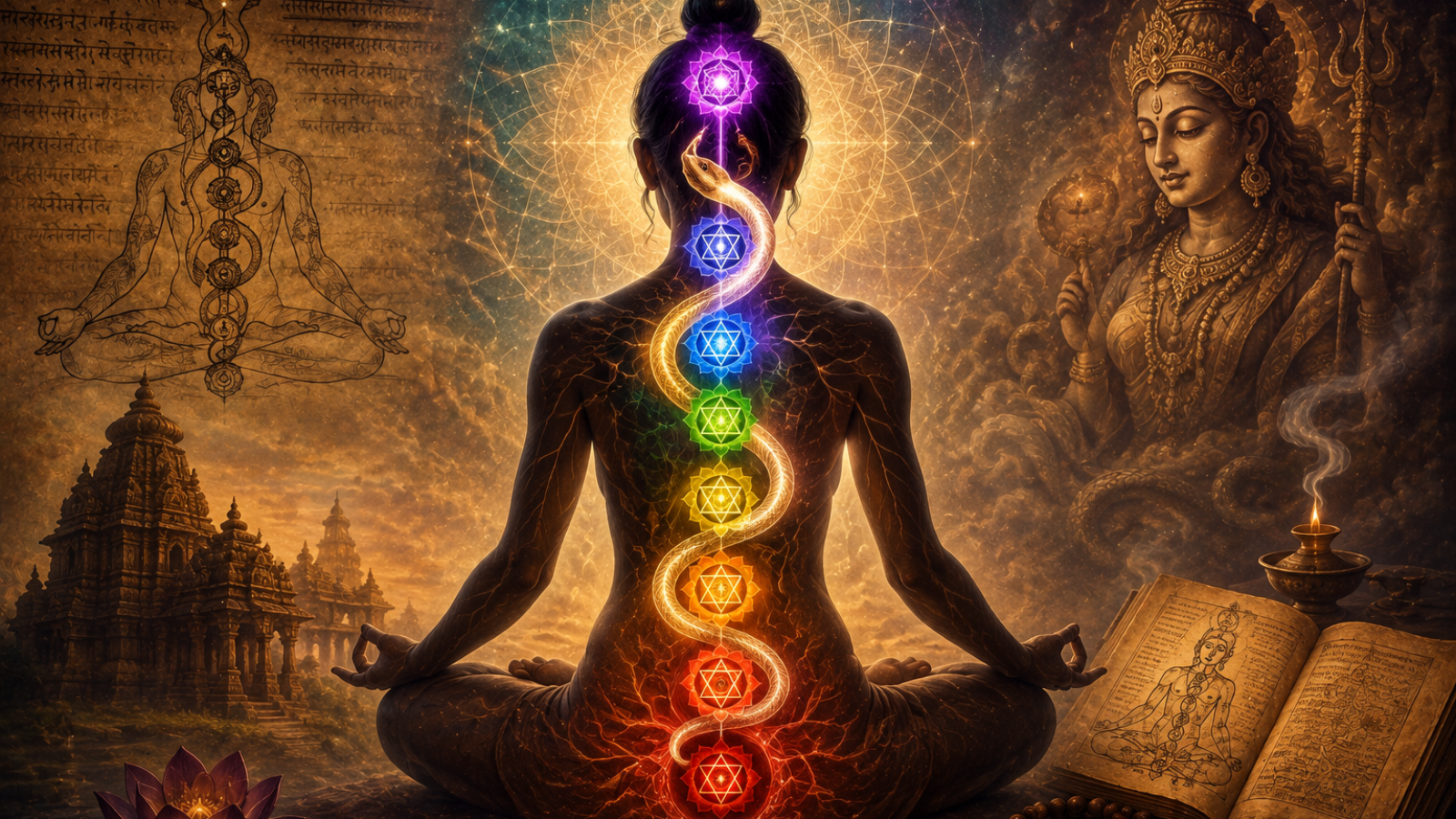
A coiled serpent sleeps at the base of the spine. Wake it, and it rises through a central channel, piercing a series of energy centres until it reaches the crown of the head, where it produces liberation. That description is repeated so consistently in modern yoga that it can seem timeless. It is not. Nearly every element of it can be dated, and several of the most familiar features are younger than the electric light bulb.

The Word and the Image

Kundalini derives from kundala, meaning coiled or ringed. The Sanskrit is feminine, and the tradition treats her as a goddess, a form of Shakti, divine energy conceived as female. The serpent image appears in hatha and tantric texts from roughly the tenth century onward. The Hatha Yoga Pradipika, compiled about 1450, describes kundalini as coiled like a serpent and asleep, closing the mouth of the sushumna, the central channel.

Wake her, Svatmarama writes, and she rises. What the text does not do is describe the experience in the terms modern readers expect. There is no talk of trauma release, no psychological framing, and no suggestion that this is something a beginner should attempt.

Where It Actually Comes From

Kundalini belongs to tantra, not to classical yoga. Patanjali does not mention it. The Yoga Sutras, compiled somewhere around 350 to 450 CE, contain no serpent, no chakras and no central channel in the tantric sense.

Tantric traditions developed from roughly the sixth century onward, in both Hindu and Buddhist contexts, though the earliest datable texts are later still. They took a distinctive position. The body is not an obstacle to liberation. It is the site of it. Divine energy is already present in the practitioner. Practice is about waking it, not about escaping the body that holds it.

Hatha yoga inherited all of it. The Hatha Yoga Pradipika, the Shiva Samhita and the Gheranda Samhita each treat kundalini as central. Their techniques exist largely to move it: the breath retentions, the locks, the seals.

The Anatomy Nobody Can Dissect

The system these texts describe has its own map. The nadis are channels through which energy travels. Texts give varying numbers, commonly 72,000. Three matter most: the ida on the left, the pingala on the right, and the sushumna running through the centre.

The chakras are centres set along the sushumna. The familiar seven-chakra system runs from muladhara at the base to sahasrara at the crown. It comes largely from one text. The Sat-Chakra-Nirupana, composed in 1577. That date is worth holding onto, because it is often assumed to be far older. Other tantric traditions counted differently. Some describe five centres. Some four. Some nine. Buddhist tantric texts commonly use four. The idea that there is one correct number, and that the number is seven, came later.

How the West Got It

Two men are responsible for most of what English-speaking readers believe about kundalini.

Sir John Woodroffe was a British judge in Calcutta. Writing as Arthur Avalon, he published The Serpent Power in 1919. It contained translations of the Sat-Chakra-Nirupana and one other sixteenth-century text. It was the first substantial account of chakra theory in English. Almost every subsequent Western account traces back to it, usually without knowing that it does.

Carl Jung gave a seminar on kundalini yoga in 1932, reading the system psychologically, as a map of stages in the development of consciousness. That reinterpretation, from an energetic process to a psychological one, is enormously influential and is not what the source texts say.

The rainbow colour scheme associated with the chakras, red at the base ascending to violet at the crown, is a twentieth-century Western addition. It does not appear in the Sanskrit sources, which assign colours differently and inconsistently.

Yogi Bhajan brought a system he called Kundalini Yoga to the United States in 1968, and it became widely taught. It draws on Sikh and yogic elements and is a modern synthesis rather than a transmission of the medieval material.

What the Practices Actually Were

The techniques the medieval texts describe are more physical and more specific than the modern vocabulary suggests. The bandhas are muscular locks. Mula bandha at the pelvic floor, uddiyana bandha drawing the abdomen up and back, jalandhara bandha at the throat. Applied together during breath retention, they are said to seal energy into the central channel.

The mudras go further. Khechari mudra involves lengthening the tongue over months. Some accounts describe cutting the frenulum by degrees. The aim is to turn the tongue back into the nasal cavity. Vajroli mudra concerns seminal retention. These are not metaphors, and they were not taught casually. The texts describe them as secret, requiring a teacher, and dangerous without one. Modern kundalini classes include almost none of this. Worth remembering when a sequence is described as ancient.

The Texts Warn You

Classical sources treat this as dangerous, and they say so directly. The Hatha Yoga Pradipika compares pranayama practice to taming a lion, tiger or elephant: done gradually it can be controlled, done carelessly it kills the practitioner. It insists on a qualified teacher and on preparation.

Clinical literature has documented cases in which intensive meditative practice preceded acute psychological difficulty. The condition is sometimes called kundalini syndrome or spiritual emergency. Neither term is a recognised diagnosis, the mechanism is disputed, and the reported cases are not numerous enough to establish how common the problem is. What is not seriously contested is that intensive practices affecting breath and attention can destabilise some people. The medieval texts assumed a full-time renunciate with a teacher present. That is not the context in which most people encounter these techniques today.

This article describes a tradition. It is not instruction, and anybody drawn to intensive practice should work with a qualified teacher and take medical advice if they have any relevant history.

Two Ways to Read the Anatomy

Modern writing splits into two camps, and it helps to see them clearly.

The literalist reading treats the nadis and chakras as a real subtle anatomy, present in everybody, which the practices act upon directly. This is closest to what the medieval texts appear to claim. The symbolic reading, which Jung’s 1932 seminar did most to popularise, treats them as a map of psychological development. The chakras become stages of maturation. Rising energy becomes integration.

A third possibility gets less attention than either. The map may be a description of what sustained practice actually feels like from the inside, recorded by people with no vocabulary for physiology or psychology, using the categories available to them. That reading takes the reports seriously without requiring either an undiscovered anatomy or a purely metaphorical one.

What Remains

Strip away the twentieth-century additions and something genuinely old is still there. A tradition, documented across many centuries, holding that the human body contains an energy usually dormant, that specific disciplines can wake it, and that waking it changes what a person is.

Whether that describes something physiological, something psychological, or something our categories do not fit is not a question the sources set out to answer. They were interested in the method. The colours are modern. The psychology is Jung’s. The serpent is old.

Kundalini: Common Questions

What is kundalini? An energy described in tantric and hatha yoga texts as coiled and dormant at the base of the spine, which practice is said to awaken and raise through a central channel.

Is kundalini in Patanjali’s Yoga Sutras?

No. The Yoga Sutras contain no reference to kundalini, chakras or the central channel in the tantric sense.

How old is the seven-chakra system?

The familiar seven-chakra sequence comes largely from the Sat-Chakra-Nirupana, composed in 1577. Earlier tantric traditions used four, five or nine centres.

Where do the chakra colours come from?

The rainbow scheme is a twentieth-century Western addition. Sanskrit sources assign colours differently and inconsistently.

Who introduced kundalini to the West?

Sir John Woodroffe, writing as Arthur Avalon, published The Serpent Power in 1919. Carl Jung’s 1932 seminar added the psychological reading.

Is kundalini practice dangerous?

Classical texts warn about it explicitly and insist on a qualified teacher. Intensive practices affecting breath and attention can destabilise some people.

Sources consulted: Svatmarama, Hatha Yoga Pradipika, Brian Dana Akers translation; Arthur Avalon (Sir John Woodroffe), The Serpent Power (1919); James Mallinson and Mark Singleton, Roots of Yoga (2017); Georg Feuerstein, The Yoga Tradition (1998).

Sources and further reading

Primary texts are linked in public-domain translations where one exists; modern scholarship is linked to the publisher.

Joy Aditya Avatar
Bhakti Yoga

Bhakti Yoga: The Path of Devotion That Changed India

Kabir was a weaver.

Ravidas worked leather, an occupation that placed him at the bottom of the social order. Tukaram sold groceries. Namdev was a tailor. Mirabai was a Rajput princess who walked out of a palace. Andal was a girl in ninth-century Tamil country who wrote thirty verses and refused to marry any human being.

None of them were brahmins. Most did not write in Sanskrit. Between roughly the sixth century and the seventeenth, they and hundreds like them produced a body of devotional poetry that reorganised Indian religious life from below. That movement is the historical substance of bhakti yoga, and it is considerably more interesting than the definition.

The Word

Bhakti comes from the root bhaj, to share, to partake, to belong to. The usual translation is devotion, which catches the feeling and misses the mutuality.

As a path, bhakti yoga is the discipline of directing love toward the divine and offering everything through that relationship. The Bhagavad Gita gives it a full chapter, and in chapter 12 has Krishna say that those who worship with steady love are dearest to him. The Gita makes a claim with substantial consequences. This path is available to anyone, regardless of learning, birth or ritual qualification. Several centuries later, people took that seriously.

It Starts in the South

Bhakti as a mass phenomenon begins in Tamil country between roughly the sixth and ninth centuries, with two groups of poet-saints. The Alvars, twelve poets devoted to Vishnu. One, Andal, was a woman. Her Tiruppavai, thirty verses composed as a young girl, is still recited daily in Tamil households during the month of Margazhi. The Nayanars, sixty-three poets devoted to Shiva, whose hymns were collected and set to music.

What both groups did was decisive, and it can be stated in three parts. They sang in Tamil rather than Sanskrit. They performed in public, in temples and processions and streets, rather than at restricted rituals. And they framed the relationship with the divine in intensely personal terms. As lover. As parent. As child. As friend. As servant. Religion moved from a transaction conducted by specialists to a relationship conducted by anybody.

Northward, Slowly

The movement travelled north across roughly eight hundred years, taking a different form in each region and each language.

FigurePeriodRegionContribution
Ramanuja1017 to 1137Tamil NaduGave bhakti a rigorous philosophical foundation
Basavac. 1105 to 1167KarnatakaFounded the Lingayat movement, rejecting caste and temple ritual
Jnaneshwar and Namdev1275 to 1350MaharashtraMarathi devotional poetry, the Varkari tradition
Kabirc. 1440 to 1518North IndiaWeaver, critic of both Hindu and Muslim orthodoxy
Guru Nanak1469 to 1539PunjabFounder of Sikhism, in dialogue with bhakti currents
Chaitanya1486 to 1534BengalEcstatic devotion to Krishna, congregational singing
Mirabaic. 1498 to 1547RajasthanPrincess turned wandering devotee of Krishna
Tulsidasc. 1532 to 1623North IndiaRamcharitmanas, the Ramayana in Awadhi
Surdasc. 1478 to 1583North IndiaBraj poetry on Krishna’s childhood

Vernacular composition runs through all of it. Tulsidas retelling the Ramayana in Awadhi rather than Sanskrit put the story into the mouths of people who could never have read it otherwise. It is still recited across northern India.

What It Did

The bhakti poets were not running a reform programme with a manifesto. Many were entirely uninterested in social organisation and wanted only their god. The effect happened regardless. If devotion is what counts, and devotion is available to a weaver and a leatherworker and a woman who left her husband’s household, then the apparatus of ritual qualification loses its monopoly.

Kabir attacked religious formalism on both sides with a directness that still reads as startling. Basava’s community rejected caste distinction and temple brahminism outright. The resistance was real. By tradition, Mirabai’s family tried repeatedly to kill her. Bhakti figures were harassed, excluded and occasionally worse. None of this dismantled the caste system. Claiming it did would be false.

What it created was a counter-current. It had its own literature. It had its own saints and its own authority. It ran underneath the orthodox structures, and it was never fully absorbed by them.

Giving It a Philosophy

Devotional feeling on its own does not survive contact with trained philosophers. Somebody had to make the case in their language. Ramanuja did it, across a life running from 1017 to 1137.

The dominant school at the time was Shankara’s non-dualism, which held that the individual self and ultimate reality are finally identical, and that all distinction is provisional. That position is difficult for a devotee. If there is no real difference between you and the divine, there is nobody to love.

Ramanuja argued for a modified position. The self is real. The divine is real. They are distinct, and yet the self depends on the divine completely, the way a body depends on the person animating it. That gave bhakti a defensible metaphysics. Love needs two.

The Language of Love

The poetry itself is worth encountering rather than reading about. Bhakti verse borrows wholesale from the vocabulary of human love, often from its most uncomfortable registers. The devotee waits. The devotee is ignored. The devotee is jealous, humiliated, sleepless, furious. Mirabai writes as a woman who has taken Krishna as her husband. She abandoned every social obligation to do it.

The Tamil Alvars write as women pining for a lover who will not come. Chaitanya’s Bengali tradition went furthest. It built a whole theology of separation, and treated longing itself as the highest state a devotee could reach. None of this was decorative. Framing devotion as erotic and domestic love brought it into a world of feeling ordinary people already inhabited completely, with no priest required to mediate it.

Nine Ways In

The Bhagavata Purana, compiled around the ninth or tenth century, sets out navadha bhakti, nine forms devotion can take.

  • Shravana, hearing about the divine
  • Kirtana, singing
  • Smarana, remembering
  • Padasevana, service at the feet
  • Archana, ritual worship
  • Vandana, prostration
  • Dasya, the attitude of a servant
  • Sakhya, the attitude of a friend
  • Atmanivedana, complete self-offering

The range is the point. Temperament determines the form. Somebody who cannot sit still in meditation can sing. Somebody who cannot articulate a theology can serve.

Why It Outlasted the Others

Of the four classical paths, bhakti became by far the most widely practised in India, and the reasons are practical. Jnana yoga needs sustained analytical capacity. Historically it also needed access to texts, which most people did not have.

Raja yoga needs long hours of disciplined solitude.

Karma yoga needs a subtle inner shift. It is easy to describe and hard to sustain. Bhakti requires that you love something. That is not a lower bar in the sense of being easier. Mirabai gave up a kingdom, and the poetry of the movement is full of unbearable longing rather than comfort. But it is a bar almost anybody can approach, from wherever they happen to be, without permission from anyone.

Andal wrote her thirty verses and, by tradition, refused every human suitor. She would have been about sixteen. Twelve hundred years later, people in Tamil Nadu still wake before dawn in Margazhi to recite them.

Bhakti Yoga: Reader Questions

What is bhakti yoga?

The path of devotion, in which love directed toward the divine becomes the primary spiritual practice. One of the four classical paths of yoga.

What does bhakti mean?

From the Sanskrit root bhaj, to share or partake. Usually translated as devotion, though the original carries a stronger sense of belonging.

When did the bhakti movement begin? In Tamil country between roughly the sixth and ninth centuries, with the Alvar and Nayanar poet-saints, spreading north over the following eight hundred years.

Who were the main bhakti saints?

Among many: Andal, Ramanuja, Basava, Jnaneshwar, Namdev, Kabir, Mirabai, Chaitanya, Tulsidas and Surdas.

Why was the movement socially significant?

Its poets wrote in regional languages rather than Sanskrit, many came from outside brahmin communities, and the path required no ritual qualification.

What are the nine forms of devotion?

Hearing, singing, remembering, service, worship, prostration, servitude, friendship and complete self-offering, from the Bhagavata Purana.

Did bhakti end the caste system?

No. It created a lasting counter-current with its own saints and authority, but it did not dismantle the structure it operated underneath.

Sources consulted: A. K. Ramanujan, Speaking of Siva (1973) and Hymns for the Drowning (1981); John Stratton Hawley, A Storm of Songs (2015); Barbara Stoler Miller’s translation of the Bhagavad Gita.

Sources and further reading

Primary texts are linked in public-domain translations where one exists; modern scholarship is linked to the publisher.

Joy Aditya Avatar
Karma Yoga

Karma Yoga: The Path of Selfless Action

A surgeon operates for six hours and the patient dies anyway.

A teacher spends a year on a student who drops out. A farmer ploughs, plants, weeds and waters, then watches hail flatten the whole field in twenty minutes.

The Bhagavad Gita is addressed to exactly this situation. Its answer is not that these outcomes do not matter. Its answer is that the person acting was never in charge of them.

The Verse

Chapter 2, verse 47, composed sometime between the second century BCE and the second century CE, is the most quoted line in Indian philosophy and among the most misread.

You have a claim on your actions, it says, and never on their fruits. Do not let the result be your motive. And do not become attached to inaction either.

The term for craving-free action is nishkama karma. That last clause does most of the work.

Krishna blocks the obvious escape route. If outcomes are not yours to control, why act at all? Because withdrawal is itself a choice with consequences, and it is not on offer.

Three verses later, at 2.50, he gives the compressed version. Yoga is skill in action.

Why Arjuna Needed It

The setting is not abstract. Arjuna stands between two armies. He has recognised his own family in the ranks opposite. He has dropped his bow.

His paralysis comes from running the calculation. If he fights, the family structure collapses. The social order collapses after it. The harm outlives the victory. He can see all the consequences and cannot bear to cause them.

Krishna’s response is that the calculation cannot be finished. Consequences ramify past anyone’s ability to trace them. A mind insisting on knowing the outcome before it acts will simply stop, which is what has happened.

Chapter 3, verse 5, puts it flatly. Nobody remains actionless even for a moment. Not acting is not available.

Three Ways to Misread It

It is not indifference. Krishna never tells Arjuna to stop caring. Detachment operates on the craving for a particular result, not on the quality of attention brought to the work. A surgeon practising karma yoga does not operate carelessly.

It is not renunciation of work. The Gita explicitly rejects the ascetic option Arjuna reaches for. Chapter 3 argues that abandoning action while the mind still dwells on objects of sense is hypocrisy rather than discipline.

It is not fatalism. Effort remains entirely the actor’s responsibility. What gets surrendered is the claim on the harvest, not the obligation to plough.

The distinction is between two questions. Am I doing this well? stays. Will this work out for me? goes.

The Altar Moves

Vedic religion had centred on yajna, the fire sacrifice. Offerings went into flame and something was expected back.

The Gita takes that structure and relocates it. Chapter 3 reinterprets sacrifice as any action performed as an offering, with the transaction removed. The altar becomes the workplace. The offering becomes whatever the person actually does.

This is a substantial move. It says the ordinary work of an ordinary life can carry the full weight of spiritual practice, provided the relationship to results is right.

For a tradition where serious practice had largely meant leaving society, that opened the path to almost everybody.

Doing Your Own Work Badly

One of the Gita’s harder ideas appears twice, at 3.35 and again at 18.47. Better to perform your own duty imperfectly than another’s duty well.

Svadharma, one’s own duty, has a specific meaning in the Gita’s social context, tied to a person’s role and station. Modern readers have taken it in several directions.

Read narrowly, it endorses a fixed social order. Read broadly, it says something more portable. That a life spent performing somebody else’s role competently is worth less than a life spent on your own imperfectly.

Both readings have serious defenders. The text’s own framing is closer to the first. The second has been more useful to more people. Anybody quoting the verse should know which one they are using.

The Objection

There is a problem with karma yoga that deserves stating rather than smoothing over.

If a person acts without attachment to consequences, what stops them acting badly? Detachment could as easily produce a soldier who kills without troubling himself about it as a surgeon who works with full attention and releases the outcome.

This is not hypothetical. The Gita is a text in which a god persuades a reluctant man to fight, and it has been read approvingly by people whose politics were appalling.

The text’s own safeguard is that karma yoga does not stand alone. It sits inside a framework of svadharma, of devotion, and of the discernment developed through the other paths. Krishna is not saying any action performed calmly is acceptable. He is telling a specific man in a specific role that his particular obligation cannot be dodged by withdrawal.

Whether that safeguard holds has been argued about for two thousand years, and the argument has not concluded.

Acting for Others

Chapter 3 adds a second reason to keep working, and it is easy to miss.

Krishna points out that people follow the example of those they respect. If a person of standing withdraws from action, others will do the same. The word the Gita uses is lokasangraha, usually rendered as holding the world together.

The argument is straightforward. Your actions are not only yours. They demonstrate what is possible, and other people copy them.

So even someone who has personally moved past needing to act still acts. Not for themselves. For the effect of being seen doing it.

Two Modern Readers

Vivekananda published Karma Yoga in 1896, presenting it as the path for the active temperament. He argued that work done without attachment purifies the worker regardless of what the work produces.

Gandhi went further. He called the Gita his spiritual dictionary, translated it into Gujarati, and titled his commentary Anasakti Yoga, the yoga of non-attachment. The title tells you what he thought the centre of the text was.

Gandhi also read the battlefield allegorically, as the conflict inside every person rather than a historical war. That reading is now widespread. It is not the only defensible one, and the Gita’s own narrative framing is considerably more literal.

What Gandhi drew from it was a political method. Act. Sustain the action. Accept whatever comes of it. And do not let the desire for a particular outcome pull you into methods you would otherwise refuse.

Karma Yoga: Common Questions

What is karma yoga?

The path of selfless action described in the Bhagavad Gita, in which work is performed without attachment to its results.

What does Bhagavad Gita 2.47 mean?

That a person has authority over their actions but not over their outcomes, and that desire for a result should not be the motive for acting.

What is nishkama karma?

Action free of craving for its fruits. The term describes the central discipline of karma yoga.

Is karma yoga about not caring what happens?

No. Detachment applies to craving a particular result, not to the attention given to the work. The Gita explicitly rejects careless action.

Can it be practised in ordinary life?

Yes. The Gita reframes ordinary work as an offering, which was its major innovation. Spiritual practice no longer required withdrawal from society.

What is svadharma?

One’s own duty. The Gita says performing your own duty imperfectly is better than performing another’s well, a verse read both narrowly and broadly.

Where It Actually Bites

The instruction sounds mild until you try it on something you want badly.

Sending the application without rehearsing the acceptance. Doing the work properly on a project that will probably be cancelled. Raising a child with real attention and no settled expectation of who they will turn out to be.

The Gita’s claim is that somebody operating this way is not diminished but freed. Anxiety about outcomes consumes energy that could have gone into the work, and it distorts the work by bending it toward whatever seems likeliest to produce the result.

Take that away and what remains is a person able to give full attention to the only thing they ever actually controlled.

Arjuna picks up the bow at the end. The Gita does not tell us whether he was glad about it.

Drawn from Barbara Stoler Miller’s translation of the Bhagavad Gita, M. K. Gandhi’s Anasakti Yoga, and Swami Vivekananda’s Karma Yoga (1896).

Sources and further reading

Primary texts are linked in public-domain translations where one exists; modern scholarship is linked to the publisher.

Joy Aditya Avatar
raja yoga

Raja Yoga: The Ultimate Guide to the Royal Path

On 11 September 1893, a thirty-year-old Bengali monk addressed the World’s Parliament of Religions in Chicago. He had arrived in America without an invitation. He had briefly slept in a railway freight car. He spoke for a few minutes, and the response was extraordinary enough to launch a lecture career across the United States and Britain. Three years later Swami Vivekananda published a book called raja yoga. It did more than any other single text to shape what the world now understands yoga to be. It also quietly redefined the term in its title.

What the Words Meant Before Him

In medieval Indian texts, raja yoga generally did not name a method. It named a destination. The Hatha Yoga Pradipika uses the term for the goal that hatha practice leads toward, a state equivalent to samadhi. Its opening verses call hatha a stairway for those wishing to reach raja yoga. Stairway and summit, not two competing schools.

Earlier still, the Amanaska Yoga, usually dated to around 1150, treats raja yoga as the highest state, defined by the dissolution of the mind rather than by any particular technique. Rajah means king. The sense is royal the way a capital is a royal city. The best of its kind. The thing everything else serves.

What He Made It Mean

Vivekananda took the term and attached it to Patanjali’s eight-limbed system. In his framing, raja yoga became one of four parallel paths. The other three were karma yoga, bhakti yoga and jnana yoga. Each suited a different temperament. Action for the energetic. Devotion for the emotional. Knowledge for the analytical. And raja yoga for those drawn to the study of their own minds.

That fourfold scheme is now taught almost universally as classical yoga. Its clearest and most influential expression is his. He also translated the Yoga Sutras. And he framed them for a specific audience in a specific decade. Western readers in the 1890s were interested in science. They were interested in the new field of psychology. Above all, they wanted claims that could be tested.

So he presented raja yoga as an experimental science of the mind. Not belief. Not revelation. A method producing verifiable results in the practitioner’s own experience. He was explicit about the framing, and it persuaded because it met his audience exactly where it stood.

What the Path Involves

Whatever the history of the label, the content Vivekananda organized under it is coherent, and it is Patanjali’s. The system runs through the eight limbs, with the weight falling heavily on the last four. The first two, yama and niyama, set an ethical foundation. Ten commitments covering conduct toward others and personal observance.

Asana is a seat steady and comfortable enough not to distract. Pranayama regulates the breath, and through it, attention.

Pratyahara is the hinge. The senses disengage from their objects and follow the mind instead. After this, everything is internal.

Dharana is concentration on a single point. Dhyana is that concentration becoming continuous. Samadhi is absorption in which the sense of a separate observer dissolves.

The central proposition is Patanjali’s second sutra. Yoga is the stilling of the fluctuations of the mind. In Vivekananda’s presentation, raja yoga is a direct assault on that problem, working on the mind through the mind. It is the most psychologically technical of the four paths, and the least dependent on either physical practice or devotional feeling.

The practical shape of it is unglamorous. Vivekananda recommended short daily sessions held consistently rather than long occasional ones. A fixed time and place. An upright spine. Attention returned to the breath or to a chosen point whenever it wandered. He was explicit that results come slowly, and that most of the practice consists of failing to concentrate and starting again.

What He Left Out

The selections he made are revealing.

The siddhis of Patanjali’s third chapter, the powers, get careful and slightly uncomfortable handling. He neither dismisses them nor dwells on them. For an audience simultaneously being courted by spiritualists and stage mediums, distance from anything resembling a magic trick was strategically necessary.

The devotional element gets less emphasis than the text arguably warrants. Ishvara pranidhana, surrender to a higher principle, is one of Patanjali’s five niyamas and appears repeatedly in the first chapter. In a presentation built around method rather than belief, it is awkward material.

What Vivekananda added was a vocabulary of experiment. Try this. Observe what happens in your own mind. Accept nothing on authority. Whether Patanjali would have recognized that framing is debatable. It persuaded a great many people to sit down and try.

The Text He Rescued

There is a detail that surprises most people. The Yoga Sutras were not continuously central to Indian religious life. Through much of the medieval period the text was fairly marginal. Devotional traditions overshadowed it. So did Vedanta. So, later, did hatha literature. Commentaries were written, and scholars knew the text. But it was not the standard reference point that it is now.

Vivekananda changed that. By presenting the Sutras as the intellectual core of yoga, he made them the authority they had not quite been. Which means the classical status of Patanjali is itself partly modern. The text is old. Its central position is recent.

Why It Worked So Well

Elizabeth De Michelis, whose A History of Modern Yoga (2004) traced this development in detail, argued that Vivekananda’s raja yoga became the template for essentially all modern yoga presented as spiritual practice rather than exercise. Several things converged. The book arrived at the right moment. Western esoteric movements, Theosophy above all, had already built an audience curious about Indian thought.

But that audience was working from secondary sources. Vivekananda offered a primary tradition, with a monk attached to it. He wrote in English, fluently, with an argumentative style shaped by a Western-educated Calcutta upbringing. And the rationalist framing gave permission. A reader could take up meditation as an experiment rather than a conversion, which mattered enormously in 1896. The effect ran both ways. Indian reformers afterwards encountered their own tradition partly through vocabulary Vivekananda had built for foreigners.

The Other Rajah Yoga

One further complication, worth flagging because it causes real confusion online. The Brahma Kumaris, a movement founded in Hyderabad, Sindh, in 1936, teach a practice they also call Rajah Yoga. It is a distinct system with its own cosmology and meditation method, unconnected to Patanjali’s eight limbs. Both usages are current. Neither is the medieval one.

Where the Word Ended Up

Somebody searching for raja yoga today will find it described as the path of meditation, one of four, based on Patanjali. That description is coherent, widely taught, and roughly 130 years old. Somebody reading a fifteenth-century hatha text will find raja yoga used to mean samadhi itself, which hatha practice is a method of reaching.

Both usages are real. The second is older. The first is what almost everybody means now. Traditions do this constantly, and pretending otherwise flattens something more interesting than the flattened version. A term traveled from meaning a summit to meaning the route up the mountain, and it traveled because one man in Chicago needed a word for something his audience did not yet have a category for.

Rajah Yoga: Common Questions

What is raja yoga?

In modern usage, the path of meditation based on Patanjali’s eight limbs, one of four classical paths alongside karma, bhakti and jnana yoga.

What does raja yoga mean?

Royal yoga. Rajah means king, and the term originally indicated the highest state rather than a particular method.

Is raja yoga the same as ashtanga yoga?

In Vivekananda’s framing, yes. Rajah yoga is his term for Patanjali’s eight-limbed system, which is what ashtanga means. It is unrelated to the modern Ashtanga Vinyasa posture style.

Who created the four paths of yoga?

The individual paths appear in the Bhagavad Gita and earlier literature. The specific fourfold scheme was popularized by Vivekananda in the 1890s.

What did raja yoga mean in medieval texts?

The goal rather than the method. The Hatha Yoga Pradipika uses it for the state hatha practice leads toward.

Is the Brahma Kumaris’ Rajah Yoga the same thing?

No. It is a separate twentieth-century system with its own cosmology, unconnected to Patanjali’s eight limbs.

Sources consulted: Swami Vivekananda, Rajah Yoga (1896); Elizabeth De Michelis, A History of Modern Yoga (2004); Svatmarama, Hatha Yoga Pradipika; Edwin Bryant, The Yoga Sutras of Patañjali (2009).

Sources and further reading

Primary texts are linked in public-domain translations where one exists; modern scholarship is linked to the publisher.

Joy Aditya Avatar
Hatha Yoga

Hatha Yoga: How Physical Yoga Became What It Is Today

Open the Hatha Yoga Pradipika, the founding text of physical yoga, written in the fifteenth century. Count the postures.

There are roughly fifteen, and most of them are ways of sitting down. A modern vinyasa class moves through more shapes than that in ten minutes. Something happened between the fifteenth century and the yoga studio, and working out what has become one of the more interesting arguments in the history of religion.

Where Hatha Came From

The word is usually explained as the union of ha, sun, and tha, moon. That reading appears in later texts. It is a devotional etymology rather than a linguistic one.

Hatha in Sanskrit means force. The tradition came out of the Nath lineage. It is linked to two semi-legendary figures, Matsyendranath and Gorakhnath. The latter is usually placed in the eleventh or twelfth century, and the tradition took shape somewhere in that window. These were ascetics working outside orthodox religion. Their concerns were not Patanjali’s.

The Yoga Sutras treat the body as a preliminary to stilling the mind. Hatha treats the body as the instrument. The physical organism, correctly worked on, becomes the means to liberation and to a range of powers along the way.

What the Medieval Texts Contain

Hatha Yoga

Four texts carry most of the tradition.

TextDateContents
Goraksha Shataka12th to 13th centuryEarly Nath material on breath and posture
Hatha Yoga Pradipikac. 1450, SvatmaramaAround 15 asanas, pranayama, mudras, cleansing acts
Shiva Samhita15th to 17th centuryDevotional framing, subtle anatomy
Gheranda Samhitac. 1650 to 170032 asanas, from a claimed 8.4 million

Read them and the proportions are surprising. Posture takes up a small fraction. The bulk of the material covers something else entirely.

Pranayama. Breath retention practices far more extreme than anything taught in a modern class.

Shatkarma. Six cleansing acts. One involves drawing water through the nose. Another involves swallowing a strip of cloth.

Mudras and bandhas. Internal locks and seals, meant to redirect energy.

Subtle anatomy. The nadis, channels through which energy travels. The central one is the sushumna. Coiled at its base is kundalini, said to rise through it.

Chakras. The centres set along that central channel.

The goal in these texts is explicit and physical. Wake kundalini, drive it upward, and reach a state the Pradipika itself calls raja yoga.

Who These People Were

The Nath yogis were not respectable. They lived outside village society. Many were wandering ascetics. Some were householders who had left. They took disciples regardless of caste, which orthodox brahmins found offensive, and they claimed powers that made ordinary people nervous.

Later Sanskrit literature often treats them with suspicion. Popular tradition treats them with awe. Both reactions tell you the same thing. These were outsiders whose practices nobody else fully understood. They also travelled. Nath lineages spread across northern India, into Nepal, and as far as Afghanistan. That mobility is part of why hatha ideas turn up in so many later traditions.

The Twentieth Century Problem

So how did fifteen seated postures become a global movement built on sequences of standing poses? The pivotal figure is Tirumalai Krishnamacharya, who lived from 1888 to 1989 and taught at the Mysore Palace from 1926 to 1946 under the Maharaja’s patronage.

His students changed the world. B.K.S. Iyengar developed a precision method using props, set out in Light on Yoga in 1966. K. Pattabhi Jois systematised the fast breath-linked sequences that became Ashtanga Vinyasa. Indra Devi carried the practice to Hollywood and then to Latin America. T.K.V. Desikachar, his son, built an individualised approach. Nearly every widely practised style of physical yoga traces back to that one room in Mysore.

The Argument About the Postures

In 2010 the scholar Mark Singleton published Yoga Body. He argued that modern postural yoga owed a substantial debt to sources outside the hatha tradition. European gymnastics. Scandinavian physical culture. Indian wrestling and body-building traditions. The gymnastic manuals in circulation at the Mysore Palace itself. The book landed hard. It suggested that sun salutations and standing sequences, presented everywhere as ancient, were largely twentieth-century constructions.

The picture has since become more complicated, in useful ways. Two things happened. Scholars looked at far more manuscripts. And they found that the standard four texts were not the whole story. James Mallinson and Singleton’s later collaboration, Roots of Yoga (2017), drew on a far wider body of Sanskrit manuscripts than anyone had previously surveyed. Jason Birch’s work on later hatha texts turned up medieval sources containing considerably more complex and non-seated postures than the four standard texts suggest.

Birch’s surveys in particular found manuscripts describing dozens of postures, including standing and balancing ones, in texts that had simply never been catalogued or translated. The four famous hatha works turn out to be a small and unrepresentative sample of what medieval practitioners were actually doing.

The current position, roughly stated. Modern postural yoga is neither an unbroken ancient transmission nor a twentieth-century invention. It is a real tradition that was reshaped, expanded and reoriented during a specific period, drawing on both Indian ascetic practice and modern physical culture.

Historians are still arguing about the proportions, and the argument is healthier than either extreme it replaced.

The Body as an Argument

There is a philosophical claim buried under the physical instruction, and it is easy to miss. Classical yoga, following Samkhya, treats the material world including the body as something consciousness must be disentangled from. Liberation means recognising that you were never the mechanism.

Hatha inverts the emphasis. The body is not the obstacle. It is the apparatus, and a perfected body counts as evidence of a perfected practitioner. The Hatha Yoga Pradipika lists physical signs of success. Slenderness. Brightness of face. Clarity of voice. Freedom from disease. That is a different theology, arrived at by people doing different things. It is one reason the two traditions produce such different practices from a shared vocabulary.

What Was Being Sought

The medieval hatha practitioner was not after flexibility, stress relief or a better back.

The texts promise siddhis, powers. They promise bodily perfection, described in some passages as freedom from disease and even from death. They promise the awakening of dormant energy and liberation through the body rather than despite it.

Some of the practices were dangerous, and the texts say so. The Pradipika warns that pranayama performed incorrectly causes illness, and compares the practitioner to somebody taming a wild animal.

This was a system built by full-time renunciates, often living outside society, undertaking practices with acknowledged risk in pursuit of goals no modern studio advertises.

How to Hold This Honestly

None of it makes a physical practice illegitimate. Hatha yoga is a real tradition with a documented literature going back a thousand years, and modern postural yoga is a genuine development of it rather than a fraud. What the history retires is one particular sales pitch. The sequence of poses taught in a class this evening is not five thousand years old. Some elements are medieval. Some are modern. The assembly is recent.

The Hatha Yoga Pradipika opens by calling hatha a stairway for those who wish to reach raja yoga. A stairway is useful. Svatmarama simply assumed everybody knew it led somewhere.

Questions About Hatha Yoga’s History

What is hatha yoga? A medieval Indian tradition, emerging around the tenth to twelfth centuries, that treats the physical body and its energies as the primary instrument of spiritual practice.

What does hatha mean? Force, in Sanskrit. The popular reading of ha as sun and tha as moon appears in later devotional texts rather than in the word’s origin.

How many postures are in the Hatha Yoga Pradipika? Around fifteen, most of them seated. The seventeenth-century Gheranda Samhita describes thirty-two.

Is modern yoga the same as traditional hatha yoga? No. Modern postural yoga developed substantially in the twentieth century, particularly through Krishnamacharya and his students.

Who was Krishnamacharya? An Indian teacher, 1888 to 1989, who taught at the Mysore Palace. His students Iyengar, Pattabhi Jois, Indra Devi and Desikachar shaped nearly all widely practised modern styles.

What are the shatkarmas? Six cleansing practices described in hatha texts, including drawing water through the nose and swallowing a cloth strip to clean the stomach.

Did medieval practitioners do standing poses? Recent manuscript research suggests more of them did than the four famous texts indicate. The question is actively being revised.

Sources consulted: James Mallinson and Mark Singleton, Roots of Yoga (2017); Mark Singleton, Yoga Body (2010); Svatmarama, Hatha Yoga Pradipika, Brian Dana Akers translation; Jason Birch, published work on later hatha texts.

Related reading

Sources and further reading

Primary texts are linked in public-domain translations where one exists; modern scholarship is linked to the publisher.

Joy Aditya Avatar