

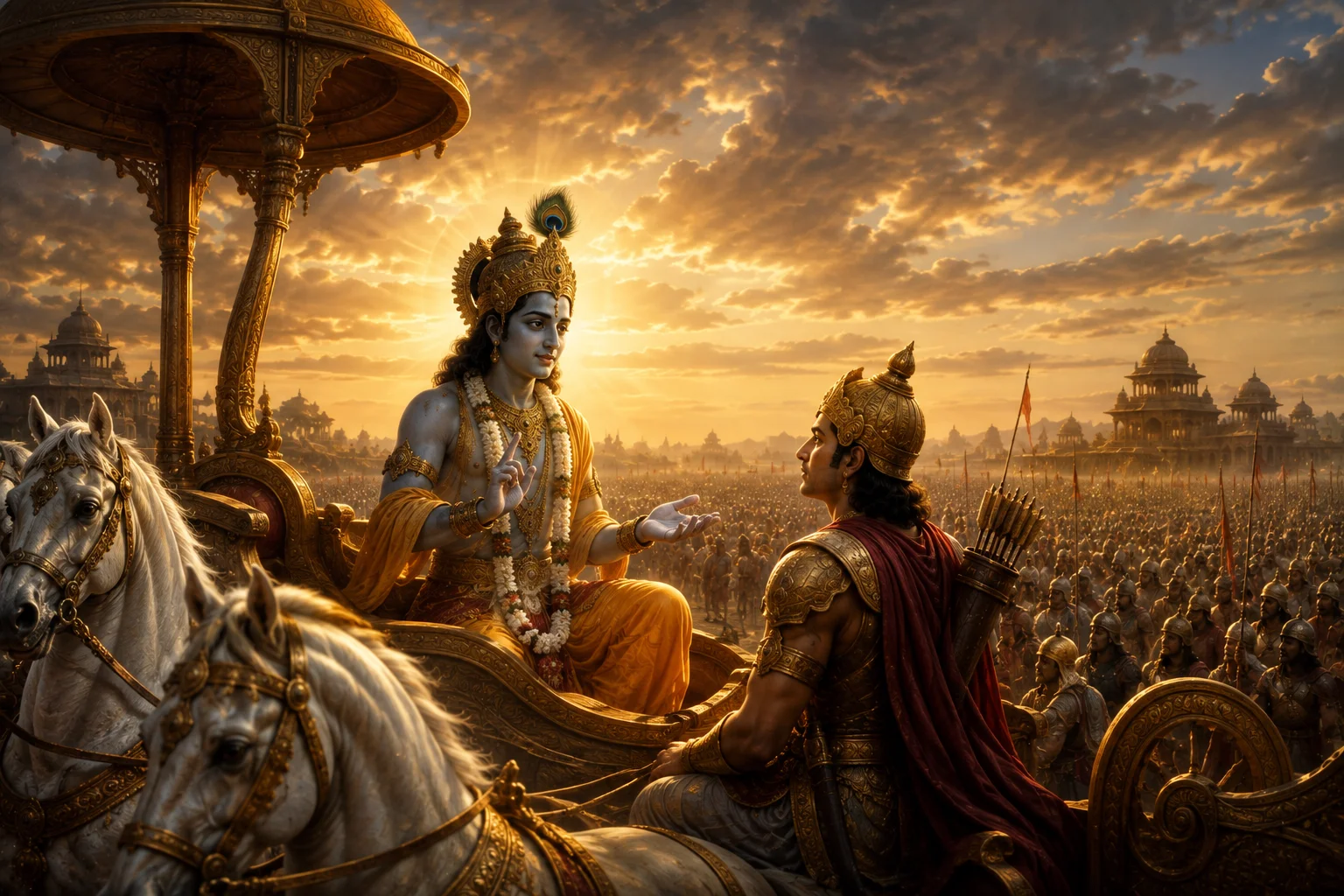
Two armies are drawn up facing each other, and one man asks his driver to take him into the gap between them so he can see who he is about to fight.
He looks. And in the ranks opposite he finds his cousins, his teachers, the grandfather who raised him, men he has eaten with and learned from and loved.
Arjuna is the finest archer alive. His hands start shaking. His bow slips out of them. He sits down in the chariot and says he will not do this.
The Bhagavad Gita begins with a professional soldier having a complete collapse, and the first chapter is titled, without euphemism, the yoga of despair.
Where the Text Sits
The Gita is not a standalone scripture. It is 700 verses across 18 chapters embedded inside the Mahabharata, one of the longest poems ever composed, arriving in the Bhishma Parva just as the war is about to start.
Dating is uncertain and contested. Most scholars place its composition somewhere between the second century BCE and the second century CE, possibly assembled over time rather than written at once.
The dramatic situation is doing something specific. Everything Krishna says is being said in the narrow window before a catastrophe, to a man who has run out of time to think. It is a text about action delivered at the last possible moment when action is still available.
Arjuna’s Argument Is Good
It matters that the Gita gives him a real case rather than a straw man.
Arjuna is not squeamish. He argues that killing his own family will destroy the family structure, that the collapse of family structure corrupts the social order, and that the resulting harm outlives any victory. He would rather be killed unarmed and unresisting than win at that price.
That is not cowardice, and Krishna never treats it as cowardice. He treats it as a mistake about the nature of the self and about what action actually is.
The Answer, and Its Most Famous Line
“You have a right to perform your prescribed duties, but you are not entitled to the fruits of your actions.” — Bhagavad Gita 2.47
Krishna’s response develops across the whole text, but the hinge is verse 2.47, which is probably the single best-known line in Indian philosophy.
You have a claim on your actions, it says, and never on their results. Do not let the fruit of action be your motive, and do not become attached to inaction either.
This is nishkama karma, action without craving for outcome, and it is subtler than it first looks.
It is not indifference. Krishna is not telling Arjuna that nothing matters, or that he should stop caring what happens. He is telling him to sever the link between doing the right thing and being paid for it.
Outcomes depend on countless conditions outside anybody’s control. Intent and effort do not. Locate yourself where you actually have authority, and the paralysis that comes from calculating consequences forever loses its grip.
Three Roads
The reason the Gita became foundational for yoga rather than remaining a war poem is that it lays out distinct paths and refuses to rank them absolutely.
Karma yoga is the path of action. Not renunciation of work but renunciation of attachment to its results. This is the answer to Arjuna’s immediate problem, and it is the path that fits people whose lives are full of obligations they cannot walk away from.
Jnana yoga is the path of knowledge. Discrimination between what is real and what merely appears so, between the changing and the unchanging, between the self and everything the self is not. It suits temperaments that move by analysis.
Bhakti yoga is the path of devotion. Love directed toward the divine, offering everything as an act of relationship. Chapter 12 gives it particular weight, and Krishna says at several points that this path is accessible to anyone regardless of learning or social position, which had significant social consequences in later centuries.
Chapter 6 adds dhyana yoga, the path of meditation, with practical instruction on seat, posture and steadiness of gaze.
The Gita’s actual position is that these are entry points, not competing brands. They converge. What differs is temperament, and the text is unusually relaxed about people choosing according to their nature.
The Chapter Nobody Is Ready For
In Chapter 11, Arjuna asks to see Krishna as he really is.
Krishna grants him a kind of vision he could not otherwise possess, and what Arjuna sees is the vishvarupa, the universal form: everything that exists, all at once, without beginning or end, mouths and eyes without number, all the warriors on both sides of the field already rushing into it and being destroyed.
Arjuna is terrified. He apologises for every casual thing he ever said to a friend he now realises he did not understand, and asks to see the familiar form again.
The chapter functions as a reminder that the Gita is not a self-improvement manual with a philosophy section. It is a religious text, and it knows how frightening its own claims are.
It is worth noting what the Gita does not argue. It does not claim that duty always overrides conscience, and it does not present war as good. Krishna’s case rests on Arjuna’s specific situation, his particular role, and a metaphysics in which the self is not destroyed by the destruction of the body.
Whether that argument works is a question people have been taking seriously, and disagreeing about, for a very long time.
Same Book, Different Conclusions
Did You Know?
The Bhagavad Gita has been translated into more than 100 languages and has influenced philosophers, spiritual leaders, writers, and political thinkers around the world for over two centuries.
The Gita’s authority is measurable in who bothered to argue about it.
Shankara read it as teaching non-dualism, in which the individual self and Brahman are ultimately one and the world’s separateness is provisional. Ramanuja read it as qualified non-dualism, preserving a real relationship between devotee and divine. Madhva read it as straightforwardly dualist.
Three of the most formidable minds in Indian philosophy read the same 700 verses and reached three incompatible conclusions, each writing a full commentary to prove it.
In the twentieth century, Gandhi called the Gita his spiritual dictionary and wrote his own commentary reading the battlefield as an allegory for the conflict inside every person. That reading is now widespread and is not the only defensible one; the text’s own framing is considerably more literal.
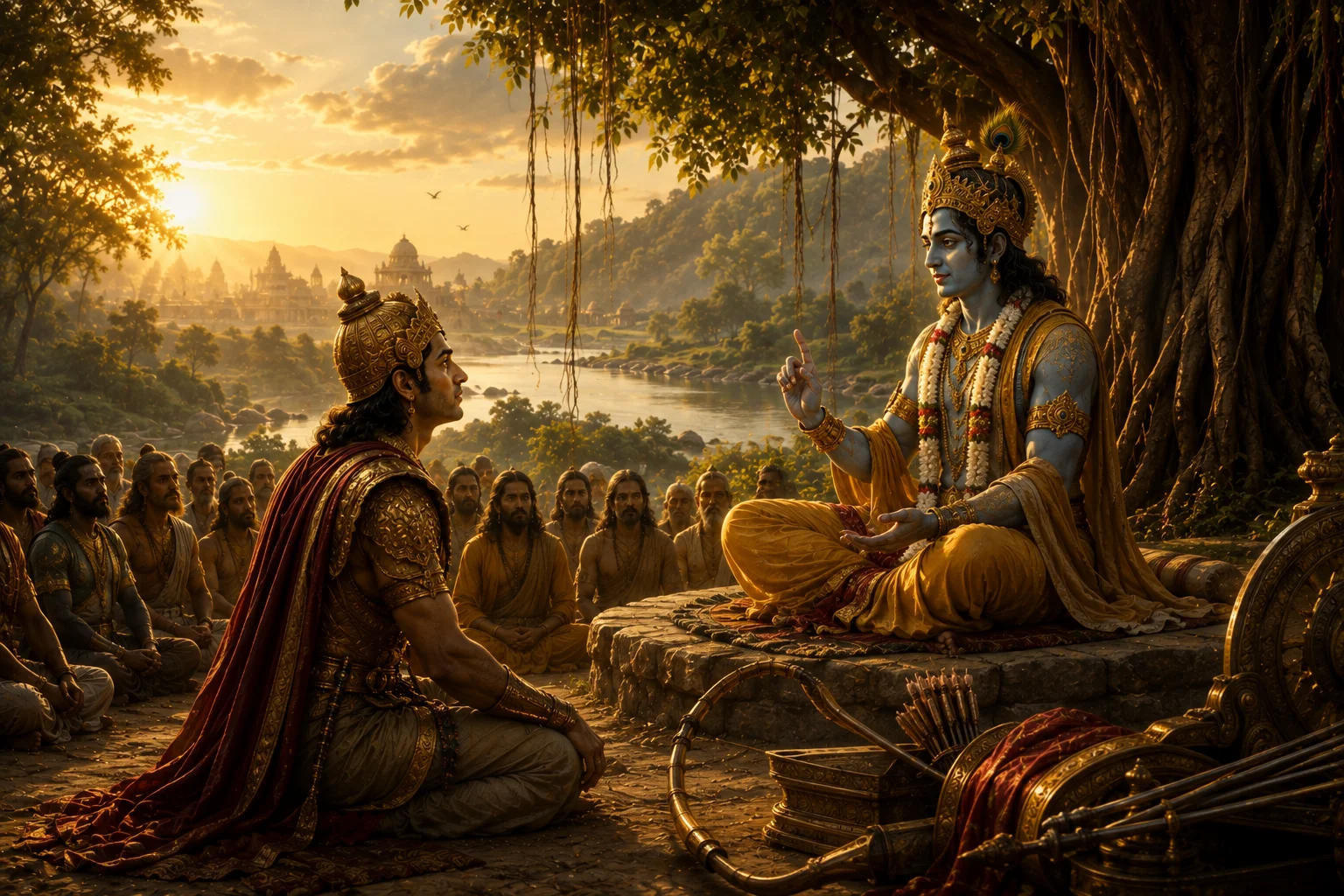
This illustration is AI-generated for educational purposes and represents an artistic interpretation of the scene described in the Bhagavad Gita.
Back in the Chariot
The Gita ends with Arjuna saying his confusion is gone and he will do what he has been told.
Whether that constitutes a resolution has been argued over for two thousand years, which is roughly the mark of a text worth arguing over.
What is not in dispute is what the Gita did for yoga. Before it, yoga was largely the business of ascetics who had withdrawn from ordinary life. After it, there was a serious argument that a person with a job, a family and obligations they could not abandon might practise just as fully as someone in a cave.
Most people who practise yoga today are, whether they know it or not, standing on that argument.
Common Questions
What is the Bhagavad Gita?
A 700-verse dialogue between Arjuna and Krishna, set on a battlefield, forming part of the Mahabharata and generally dated between the second century BCE and second century CE.
What are the three paths of yoga in the Gita?
Karma yoga, the path of selfless action; jnana yoga, the path of knowledge; and bhakti yoga, the path of devotion. Chapter 6 adds dhyana yoga, meditation.
What does verse 2.47 mean?
That you have authority over your actions but not over their outcomes, and that attachment to results should not be the motive for acting.
Is the Gita’s battlefield literal or symbolic?
The text presents it as literal, within the Mahabharata narrative. Gandhi and others read it allegorically as the inner conflict of the individual, and both readings are current.
Which path does the Gita say is best?
It does not rank them absolutely. Different chapters emphasise different paths, and the text treats them as suited to different temperaments.
Why is the Gita important to yoga?
It made the case that yoga could be practised within an active life of duty and relationship, rather than requiring withdrawal from the world.
Sources consulted: The Bhagavad Gita, Barbara Stoler Miller translation; The Bhagavad Gita, Eknath Easwaran translation; M. K. Gandhi, Anasakti Yoga; Encyclopaedia Britannica, “Bhagavadgita”.
Related reading
- Karma Yoga: The Path of Selfless Action
- Bhakti Yoga: The Path of Devotion
- Moksha: The Real Goal of Yoga
Sources and further reading
Primary texts are linked in public-domain translations where one exists; modern scholarship is linked to the publisher.
Leave a Reply