


For roughly three thousand years, the oldest sacred texts in India were not written down.
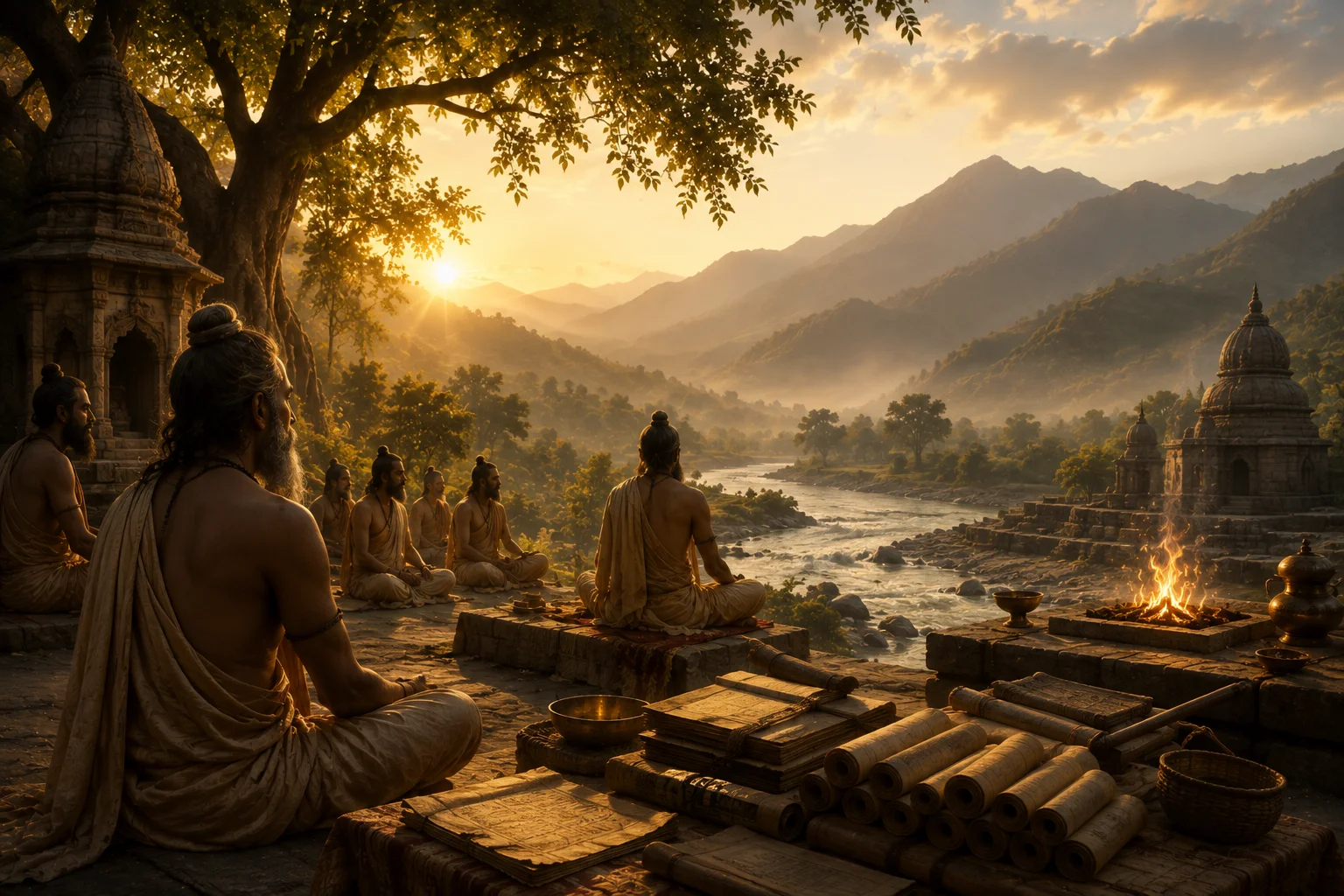
They were held in people. Families of reciters memorised the Rigveda syllable by syllable, tone by tone, and passed it to their children using a set of verification techniques that border on the obsessive. In one method, jata-patha, the reciter chants each pair of words forwards, then backwards, then forwards again. In another, ghana-patha, the pattern becomes more elaborate still. The point was to make it impossible for an error to survive a single transmission.
When printed editions were finally compared across regions of India separated by a thousand kilometres and many centuries of independent transmission, they matched almost exactly.
Hold that in mind before asking whether yoga began in the Vedas, because the answer is bound up in what kind of culture this was.
What the Vedas Are
Veda comes from the Sanskrit root vid, to know. The word means, roughly, the knowledge, and Hindu tradition treats these texts as shruti, that which was heard, revealed to seers rather than composed by them.
There are four.
The Rigveda is the oldest, a collection of over a thousand hymns addressed to deities including Agni, Indra and Varuna. Most scholars place its composition somewhere between 1500 and 1200 BCE, making it among the oldest religious texts anywhere still in continuous ritual use. The Yajurveda supplies the formulas for performing sacrifice. The Samaveda sets Rigvedic verses to melody. The Atharvaveda, different in temperament from the others, gathers healing charms, domestic rites and reflections on ordinary life.
These were not devotional poems in the modern sense. Many are requests: for cattle, for rain, for victory, for sons, for the destruction of enemies. The Vedic world wanted things, and said so.
Vedic religion centred on yajna, the fire sacrifice. Offerings were made into flame, precisely, by trained priests, with the belief that correctly performed ritual maintained the order of the cosmos. It was an outward-facing religion. The action happened at the altar.
The Plant Nobody Can Identify
One detail gives a sense of how alien this world is from ours. An entire book of the Rigveda, the ninth, consists almost entirely of hymns to soma.
Soma is a plant, a pressed juice drunk during ritual, and a deity, all at once. The hymns describe the experience of drinking it in terms that are unmistakably ecstatic: expansion, illumination, a sense of having become vast.
Nobody knows what the plant was. Candidates have included ephedra, various mushrooms, and wild rue, and none has settled the question. The identification was lost so early that even later Indian commentators were working from substitutes.
A religion at whose centre sits a substance that produced altered states, described by people who were clearly taking it seriously, is a religion already interested in the alteration of consciousness.
So Does the Word Appear?
Yes. And it mostly means something else. Yoga derives from the root yuj, to yoke or join. In the Rigveda it generally means exactly that in the literal sense: yoking horses to a chariot, harnessing an animal, applying force to a task. It is a practical, agricultural, military word.
The spiritual reading, yoking the mind, joining the individual self to something larger, develops over the following centuries and does not appear fully formed in Rigvedic usage. So when someone says the Rigveda talks about yoga, they are right about the word and largely wrong about what it meant. This distinction is worth defending rather than smoothing over. Yoga’s antiquity is genuine and substantial. It does not require inflation, and inflating it makes the honest claims harder to believe.
Three Threads That Do Lead Somewhere
If the vocabulary was not yet there, several practices were already stirring, and each runs directly into what yoga became.
Tapas. Usually rendered as austerity, though inner heat is closer. Vedic texts describe tapas as disciplined intensity generated through restraint, effort and concentration, and describe it as powerful enough that creation itself is sometimes said to arise from it. The underlying idea, that focused inner discipline produces real transformative force, never leaves Indian thought afterwards.
Breath. The Vedas treat prana, the life breath, with serious reverence. Vedic chanting also demanded precise breath control, since long verses had to be delivered in single controlled exhalations with exact metre. A priest doing that is doing something structurally close to pranayama, whatever he would have called it.
The long-haired ones. Rigveda 10.136, usually called the Kesin hymn, describes a figure who is not a priest at all. He is silent, wind-girdled, wearing soiled saffron or nothing, and he is said to ride the wind and to drink from a cup shared with the god Rudra.
Scholars argue about who the kesins actually were. What the hymn establishes beyond much doubt is that Vedic society already contained people operating outside the sacrificial mainstream, pursuing ecstatic and inward states through their own disciplines. They are not yogis. They might reasonably be called yoga’s wild ancestors, and the fact that the Vedic tradition preserved a hymn about them at all is significant.
The Seal That Cannot Speak
Any discussion of yoga’s origins eventually reaches the Indus Valley. The site of Mohenjo-daro produced a small steatite seal, catalogued as seal 420 and often called the Pashupati seal, showing a horned figure seated with legs folded and heels together, surrounded by animals. Sir John Marshall, who excavated it in the 1920s, identified it as a proto-Shiva in a yogic posture. That reading entered popular writing and has stayed there.
It is contested, and seriously so. Other scholars read the figure as a bull-man, a deity of an unrelated tradition, or a seated ruler. The Indus script remains undeciphered, so the seal cannot tell us what it is. The honest formulation is that the seal is suggestive and unproven. It may show meditative practice predating the Vedas by a thousand years. It may show something else entirely. Anyone stating it as fact in either direction is going beyond what the evidence supports.
Where the Tree Actually Grows
The Vedic period ends with something more interesting than the seal. Toward the close of the Vedic era, attention begins to turn inward. The Brahmanas, texts explaining ritual, grow increasingly concerned with what the ritual means rather than how to perform it. The Aranyakas, the forest texts, move the discussion out of the village.
And then come the Upanishads, where the sacrificial fire is reinterpreted as something burning inside the practitioner, and the questions become explicitly about consciousness and the self. That is the moment yoga as we would recognise it becomes possible. Not in the Vedas, but not without them either. The seeds were in the soil for a long time before anything came up.
Frequently Asked Questions
Did yoga begin in the Vedas?
The seeds did. The Vedas contain tapas, reverence for breath, and references to ascetics pursuing inward states, but not yoga as a system and certainly not physical postures as practised today.
Does the word yoga appear in the Rigveda?
Yes, but usually in its literal sense of yoking or harnessing. The spiritual meaning developed over later centuries.
How old are the Vedas? T
he Rigveda is generally dated to roughly 1500 to 1200 BCE, with the other three following. They were transmitted orally for many centuries before being written.
What is the Kesin hymn?
Rigveda 10.136, describing a long-haired ascetic outside the priestly mainstream who is said to ride the wind. It is the clearest Vedic evidence of ecstatic inward practice.
Does the Pashupati seal prove yoga existed in the Indus Valley?
No. The seated figure is suggestive, but the reading is contested and the Indus script remains undeciphered. It is a possibility, not evidence.
Sources consulted: The Principal Upanishads, S. Radhakrishnan; Patrick Olivelle, Upanisads (Oxford World’s Classics); Encyclopaedia Britannica, “Upanishad”; Katha and Chandogya Upanishads, standard translations.
Related reading
- The Upanishads and the Birth of Yogic Philosophy
- What Does Yoga Really Mean?
- Patanjali and the Yoga Sutras
Sources and further reading
Primary texts are linked in public-domain translations where one exists; modern scholarship is linked to the publisher.
- The Rig Veda, translated by Ralph T. H. Griffith
- The Upanishads, Sacred Books of the East vol. 15, translated by Max Muller
- James Mallinson and Mark Singleton, Roots of Yoga (Penguin Classics)

Leave a Reply