

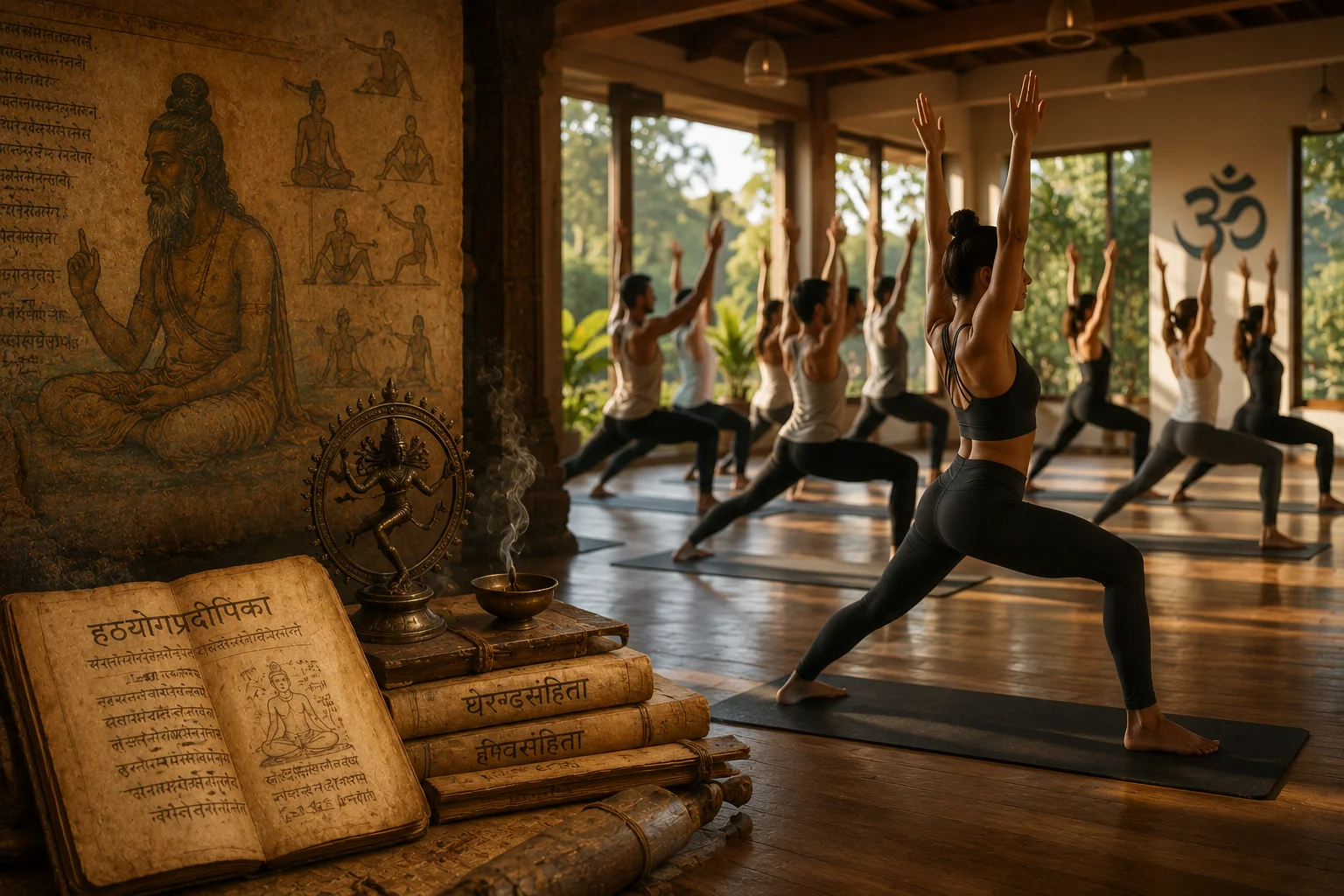
Open the Hatha Yoga Pradipika, the founding text of physical yoga, written in the fifteenth century. Count the postures.
There are roughly fifteen, and most of them are ways of sitting down. A modern vinyasa class moves through more shapes than that in ten minutes. Something happened between the fifteenth century and the yoga studio, and working out what has become one of the more interesting arguments in the history of religion.
Where Hatha Came From
The word is usually explained as the union of ha, sun, and tha, moon. That reading appears in later texts. It is a devotional etymology rather than a linguistic one.
Hatha in Sanskrit means force. The tradition came out of the Nath lineage. It is linked to two semi-legendary figures, Matsyendranath and Gorakhnath. The latter is usually placed in the eleventh or twelfth century, and the tradition took shape somewhere in that window. These were ascetics working outside orthodox religion. Their concerns were not Patanjali’s.
The Yoga Sutras treat the body as a preliminary to stilling the mind. Hatha treats the body as the instrument. The physical organism, correctly worked on, becomes the means to liberation and to a range of powers along the way.
What the Medieval Texts Contain
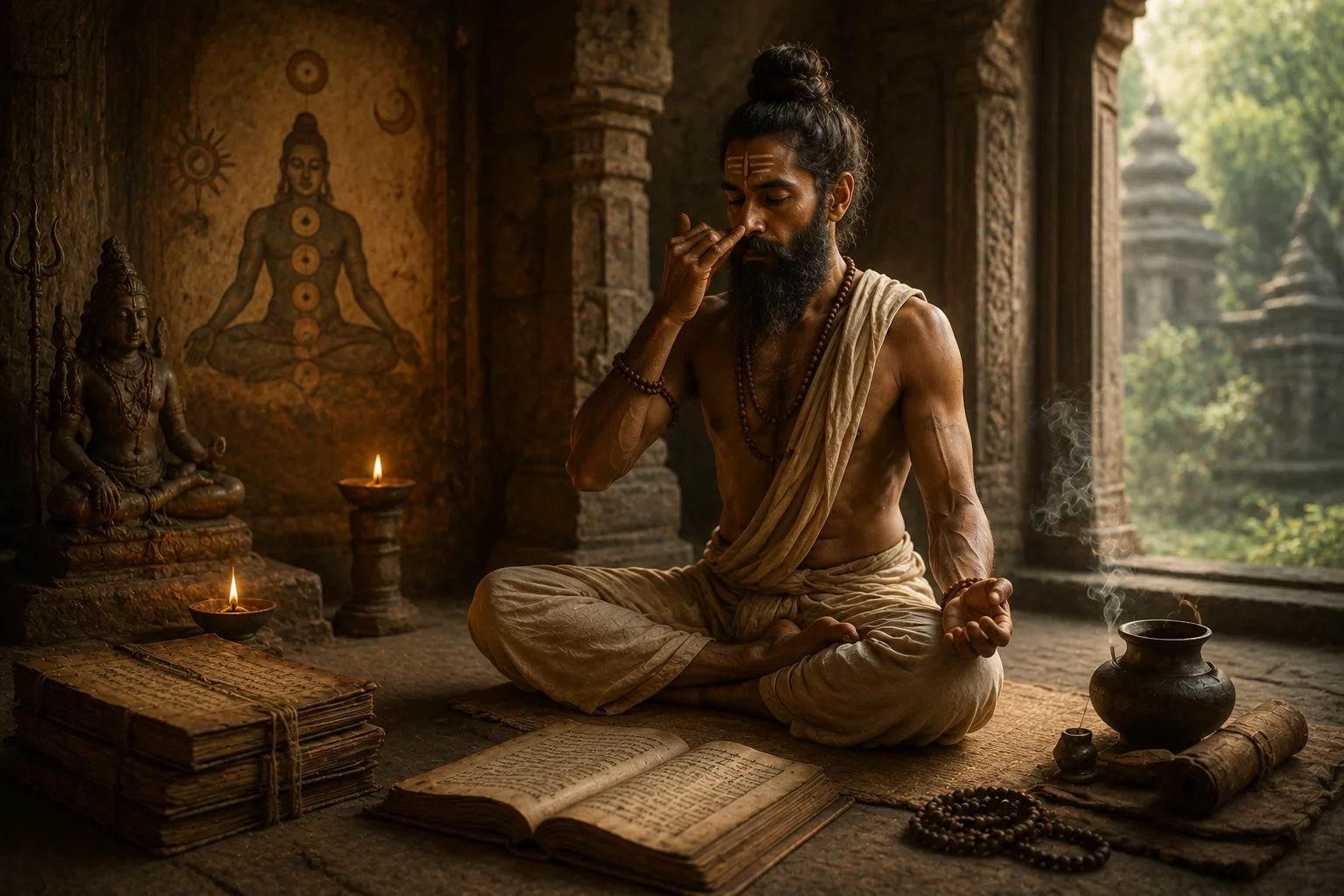
Four texts carry most of the tradition.
| Text | Date | Contents |
| Goraksha Shataka | 12th to 13th century | Early Nath material on breath and posture |
| Hatha Yoga Pradipika | c. 1450, Svatmarama | Around 15 asanas, pranayama, mudras, cleansing acts |
| Shiva Samhita | 15th to 17th century | Devotional framing, subtle anatomy |
| Gheranda Samhita | c. 1650 to 1700 | 32 asanas, from a claimed 8.4 million |
Read them and the proportions are surprising. Posture takes up a small fraction. The bulk of the material covers something else entirely.
Pranayama. Breath retention practices far more extreme than anything taught in a modern class.
Shatkarma. Six cleansing acts. One involves drawing water through the nose. Another involves swallowing a strip of cloth.
Mudras and bandhas. Internal locks and seals, meant to redirect energy.
Subtle anatomy. The nadis, channels through which energy travels. The central one is the sushumna. Coiled at its base is kundalini, said to rise through it.
Chakras. The centres set along that central channel.
The goal in these texts is explicit and physical. Wake kundalini, drive it upward, and reach a state the Pradipika itself calls raja yoga.
Who These People Were
The Nath yogis were not respectable. They lived outside village society. Many were wandering ascetics. Some were householders who had left. They took disciples regardless of caste, which orthodox brahmins found offensive, and they claimed powers that made ordinary people nervous.
Later Sanskrit literature often treats them with suspicion. Popular tradition treats them with awe. Both reactions tell you the same thing. These were outsiders whose practices nobody else fully understood. They also travelled. Nath lineages spread across northern India, into Nepal, and as far as Afghanistan. That mobility is part of why hatha ideas turn up in so many later traditions.
The Twentieth Century Problem
So how did fifteen seated postures become a global movement built on sequences of standing poses? The pivotal figure is Tirumalai Krishnamacharya, who lived from 1888 to 1989 and taught at the Mysore Palace from 1926 to 1946 under the Maharaja’s patronage.
His students changed the world. B.K.S. Iyengar developed a precision method using props, set out in Light on Yoga in 1966. K. Pattabhi Jois systematised the fast breath-linked sequences that became Ashtanga Vinyasa. Indra Devi carried the practice to Hollywood and then to Latin America. T.K.V. Desikachar, his son, built an individualised approach. Nearly every widely practised style of physical yoga traces back to that one room in Mysore.
The Argument About the Postures
In 2010 the scholar Mark Singleton published Yoga Body. He argued that modern postural yoga owed a substantial debt to sources outside the hatha tradition. European gymnastics. Scandinavian physical culture. Indian wrestling and body-building traditions. The gymnastic manuals in circulation at the Mysore Palace itself. The book landed hard. It suggested that sun salutations and standing sequences, presented everywhere as ancient, were largely twentieth-century constructions.
The picture has since become more complicated, in useful ways. Two things happened. Scholars looked at far more manuscripts. And they found that the standard four texts were not the whole story. James Mallinson and Singleton’s later collaboration, Roots of Yoga (2017), drew on a far wider body of Sanskrit manuscripts than anyone had previously surveyed. Jason Birch’s work on later hatha texts turned up medieval sources containing considerably more complex and non-seated postures than the four standard texts suggest.
Birch’s surveys in particular found manuscripts describing dozens of postures, including standing and balancing ones, in texts that had simply never been catalogued or translated. The four famous hatha works turn out to be a small and unrepresentative sample of what medieval practitioners were actually doing.
The current position, roughly stated. Modern postural yoga is neither an unbroken ancient transmission nor a twentieth-century invention. It is a real tradition that was reshaped, expanded and reoriented during a specific period, drawing on both Indian ascetic practice and modern physical culture.
Historians are still arguing about the proportions, and the argument is healthier than either extreme it replaced.
The Body as an Argument
There is a philosophical claim buried under the physical instruction, and it is easy to miss. Classical yoga, following Samkhya, treats the material world including the body as something consciousness must be disentangled from. Liberation means recognising that you were never the mechanism.
Hatha inverts the emphasis. The body is not the obstacle. It is the apparatus, and a perfected body counts as evidence of a perfected practitioner. The Hatha Yoga Pradipika lists physical signs of success. Slenderness. Brightness of face. Clarity of voice. Freedom from disease. That is a different theology, arrived at by people doing different things. It is one reason the two traditions produce such different practices from a shared vocabulary.
What Was Being Sought
The medieval hatha practitioner was not after flexibility, stress relief or a better back.
The texts promise siddhis, powers. They promise bodily perfection, described in some passages as freedom from disease and even from death. They promise the awakening of dormant energy and liberation through the body rather than despite it.
Some of the practices were dangerous, and the texts say so. The Pradipika warns that pranayama performed incorrectly causes illness, and compares the practitioner to somebody taming a wild animal.
This was a system built by full-time renunciates, often living outside society, undertaking practices with acknowledged risk in pursuit of goals no modern studio advertises.
How to Hold This Honestly
None of it makes a physical practice illegitimate. Hatha yoga is a real tradition with a documented literature going back a thousand years, and modern postural yoga is a genuine development of it rather than a fraud. What the history retires is one particular sales pitch. The sequence of poses taught in a class this evening is not five thousand years old. Some elements are medieval. Some are modern. The assembly is recent.
The Hatha Yoga Pradipika opens by calling hatha a stairway for those who wish to reach raja yoga. A stairway is useful. Svatmarama simply assumed everybody knew it led somewhere.
Questions About Hatha Yoga’s History
What is hatha yoga? A medieval Indian tradition, emerging around the tenth to twelfth centuries, that treats the physical body and its energies as the primary instrument of spiritual practice.
What does hatha mean? Force, in Sanskrit. The popular reading of ha as sun and tha as moon appears in later devotional texts rather than in the word’s origin.
How many postures are in the Hatha Yoga Pradipika? Around fifteen, most of them seated. The seventeenth-century Gheranda Samhita describes thirty-two.
Is modern yoga the same as traditional hatha yoga? No. Modern postural yoga developed substantially in the twentieth century, particularly through Krishnamacharya and his students.
Who was Krishnamacharya? An Indian teacher, 1888 to 1989, who taught at the Mysore Palace. His students Iyengar, Pattabhi Jois, Indra Devi and Desikachar shaped nearly all widely practised modern styles.
What are the shatkarmas? Six cleansing practices described in hatha texts, including drawing water through the nose and swallowing a cloth strip to clean the stomach.
Did medieval practitioners do standing poses? Recent manuscript research suggests more of them did than the four famous texts indicate. The question is actively being revised.
Sources consulted: James Mallinson and Mark Singleton, Roots of Yoga (2017); Mark Singleton, Yoga Body (2010); Svatmarama, Hatha Yoga Pradipika, Brian Dana Akers translation; Jason Birch, published work on later hatha texts.
Related reading
Sources and further reading
Primary texts are linked in public-domain translations where one exists; modern scholarship is linked to the publisher.
- Hatha Yoga Pradipika, Sanskrit and English
- Mark Singleton, Yoga Body: The Origins of Modern Posture Practice (Oxford University Press)
- James Mallinson and Mark Singleton, Roots of Yoga (Penguin Classics)
- Encyclopaedia Britannica, Hatha Yoga
- Light on Yoga, 1966: The Book That Standardised the Poses
- The Yoga Vasistha: The Longest Argument That Nothing Is Happening
- The Hatha Yoga Pradipika: How a Fifteenth-Century Compilation Became the Standard
- The Amritasiddhi: The Oldest Hatha Text Is Not What Anyone Expected
- The Samkhya Karika: The System Yoga Is Built On

Leave a Reply