

A surgeon operates for six hours and the patient dies anyway.
A teacher spends a year on a student who drops out. A farmer ploughs, plants, weeds and waters, then watches hail flatten the whole field in twenty minutes.
The Bhagavad Gita is addressed to exactly this situation. Its answer is not that these outcomes do not matter. Its answer is that the person acting was never in charge of them.
The Verse
Chapter 2, verse 47, composed sometime between the second century BCE and the second century CE, is the most quoted line in Indian philosophy and among the most misread.
You have a claim on your actions, it says, and never on their fruits. Do not let the result be your motive. And do not become attached to inaction either.
The term for craving-free action is nishkama karma. That last clause does most of the work.
Krishna blocks the obvious escape route. If outcomes are not yours to control, why act at all? Because withdrawal is itself a choice with consequences, and it is not on offer.
Three verses later, at 2.50, he gives the compressed version. Yoga is skill in action.
Why Arjuna Needed It
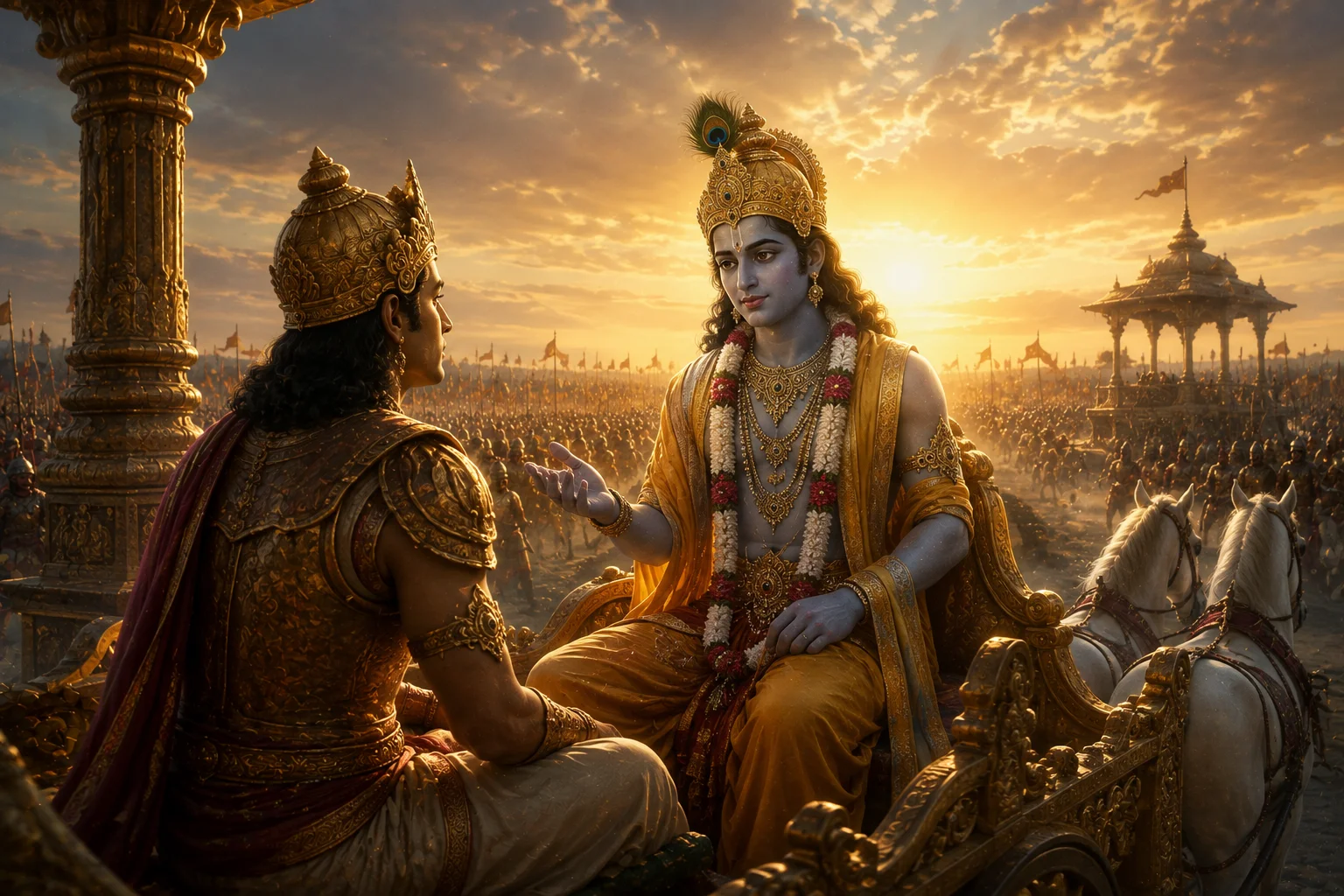
The setting is not abstract. Arjuna stands between two armies. He has recognised his own family in the ranks opposite. He has dropped his bow.
His paralysis comes from running the calculation. If he fights, the family structure collapses. The social order collapses after it. The harm outlives the victory. He can see all the consequences and cannot bear to cause them.
Krishna’s response is that the calculation cannot be finished. Consequences ramify past anyone’s ability to trace them. A mind insisting on knowing the outcome before it acts will simply stop, which is what has happened.
Chapter 3, verse 5, puts it flatly. Nobody remains actionless even for a moment. Not acting is not available.
Three Ways to Misread It
It is not indifference. Krishna never tells Arjuna to stop caring. Detachment operates on the craving for a particular result, not on the quality of attention brought to the work. A surgeon practising karma yoga does not operate carelessly.
It is not renunciation of work. The Gita explicitly rejects the ascetic option Arjuna reaches for. Chapter 3 argues that abandoning action while the mind still dwells on objects of sense is hypocrisy rather than discipline.
It is not fatalism. Effort remains entirely the actor’s responsibility. What gets surrendered is the claim on the harvest, not the obligation to plough.
The distinction is between two questions. Am I doing this well? stays. Will this work out for me? goes.
The Altar Moves
Vedic religion had centred on yajna, the fire sacrifice. Offerings went into flame and something was expected back.
The Gita takes that structure and relocates it. Chapter 3 reinterprets sacrifice as any action performed as an offering, with the transaction removed. The altar becomes the workplace. The offering becomes whatever the person actually does.
This is a substantial move. It says the ordinary work of an ordinary life can carry the full weight of spiritual practice, provided the relationship to results is right.
For a tradition where serious practice had largely meant leaving society, that opened the path to almost everybody.
Doing Your Own Work Badly
One of the Gita’s harder ideas appears twice, at 3.35 and again at 18.47. Better to perform your own duty imperfectly than another’s duty well.
Svadharma, one’s own duty, has a specific meaning in the Gita’s social context, tied to a person’s role and station. Modern readers have taken it in several directions.
Read narrowly, it endorses a fixed social order. Read broadly, it says something more portable. That a life spent performing somebody else’s role competently is worth less than a life spent on your own imperfectly.
Both readings have serious defenders. The text’s own framing is closer to the first. The second has been more useful to more people. Anybody quoting the verse should know which one they are using.
The Objection
There is a problem with karma yoga that deserves stating rather than smoothing over.
If a person acts without attachment to consequences, what stops them acting badly? Detachment could as easily produce a soldier who kills without troubling himself about it as a surgeon who works with full attention and releases the outcome.
This is not hypothetical. The Gita is a text in which a god persuades a reluctant man to fight, and it has been read approvingly by people whose politics were appalling.
The text’s own safeguard is that karma yoga does not stand alone. It sits inside a framework of svadharma, of devotion, and of the discernment developed through the other paths. Krishna is not saying any action performed calmly is acceptable. He is telling a specific man in a specific role that his particular obligation cannot be dodged by withdrawal.
Whether that safeguard holds has been argued about for two thousand years, and the argument has not concluded.
Acting for Others
Chapter 3 adds a second reason to keep working, and it is easy to miss.
Krishna points out that people follow the example of those they respect. If a person of standing withdraws from action, others will do the same. The word the Gita uses is lokasangraha, usually rendered as holding the world together.
The argument is straightforward. Your actions are not only yours. They demonstrate what is possible, and other people copy them.
So even someone who has personally moved past needing to act still acts. Not for themselves. For the effect of being seen doing it.
Two Modern Readers
Vivekananda published Karma Yoga in 1896, presenting it as the path for the active temperament. He argued that work done without attachment purifies the worker regardless of what the work produces.
Gandhi went further. He called the Gita his spiritual dictionary, translated it into Gujarati, and titled his commentary Anasakti Yoga, the yoga of non-attachment. The title tells you what he thought the centre of the text was.
Gandhi also read the battlefield allegorically, as the conflict inside every person rather than a historical war. That reading is now widespread. It is not the only defensible one, and the Gita’s own narrative framing is considerably more literal.
What Gandhi drew from it was a political method. Act. Sustain the action. Accept whatever comes of it. And do not let the desire for a particular outcome pull you into methods you would otherwise refuse.
Karma Yoga: Common Questions
What is karma yoga?
The path of selfless action described in the Bhagavad Gita, in which work is performed without attachment to its results.
What does Bhagavad Gita 2.47 mean?
That a person has authority over their actions but not over their outcomes, and that desire for a result should not be the motive for acting.
What is nishkama karma?
Action free of craving for its fruits. The term describes the central discipline of karma yoga.
Is karma yoga about not caring what happens?
No. Detachment applies to craving a particular result, not to the attention given to the work. The Gita explicitly rejects careless action.
Can it be practised in ordinary life?
Yes. The Gita reframes ordinary work as an offering, which was its major innovation. Spiritual practice no longer required withdrawal from society.
What is svadharma?
One’s own duty. The Gita says performing your own duty imperfectly is better than performing another’s well, a verse read both narrowly and broadly.
Where It Actually Bites
The instruction sounds mild until you try it on something you want badly.
Sending the application without rehearsing the acceptance. Doing the work properly on a project that will probably be cancelled. Raising a child with real attention and no settled expectation of who they will turn out to be.
The Gita’s claim is that somebody operating this way is not diminished but freed. Anxiety about outcomes consumes energy that could have gone into the work, and it distorts the work by bending it toward whatever seems likeliest to produce the result.
Take that away and what remains is a person able to give full attention to the only thing they ever actually controlled.
Arjuna picks up the bow at the end. The Gita does not tell us whether he was glad about it.
Drawn from Barbara Stoler Miller’s translation of the Bhagavad Gita, M. K. Gandhi’s Anasakti Yoga, and Swami Vivekananda’s Karma Yoga (1896).
Sources and further reading
Primary texts are linked in public-domain translations where one exists; modern scholarship is linked to the publisher.
Leave a Reply