

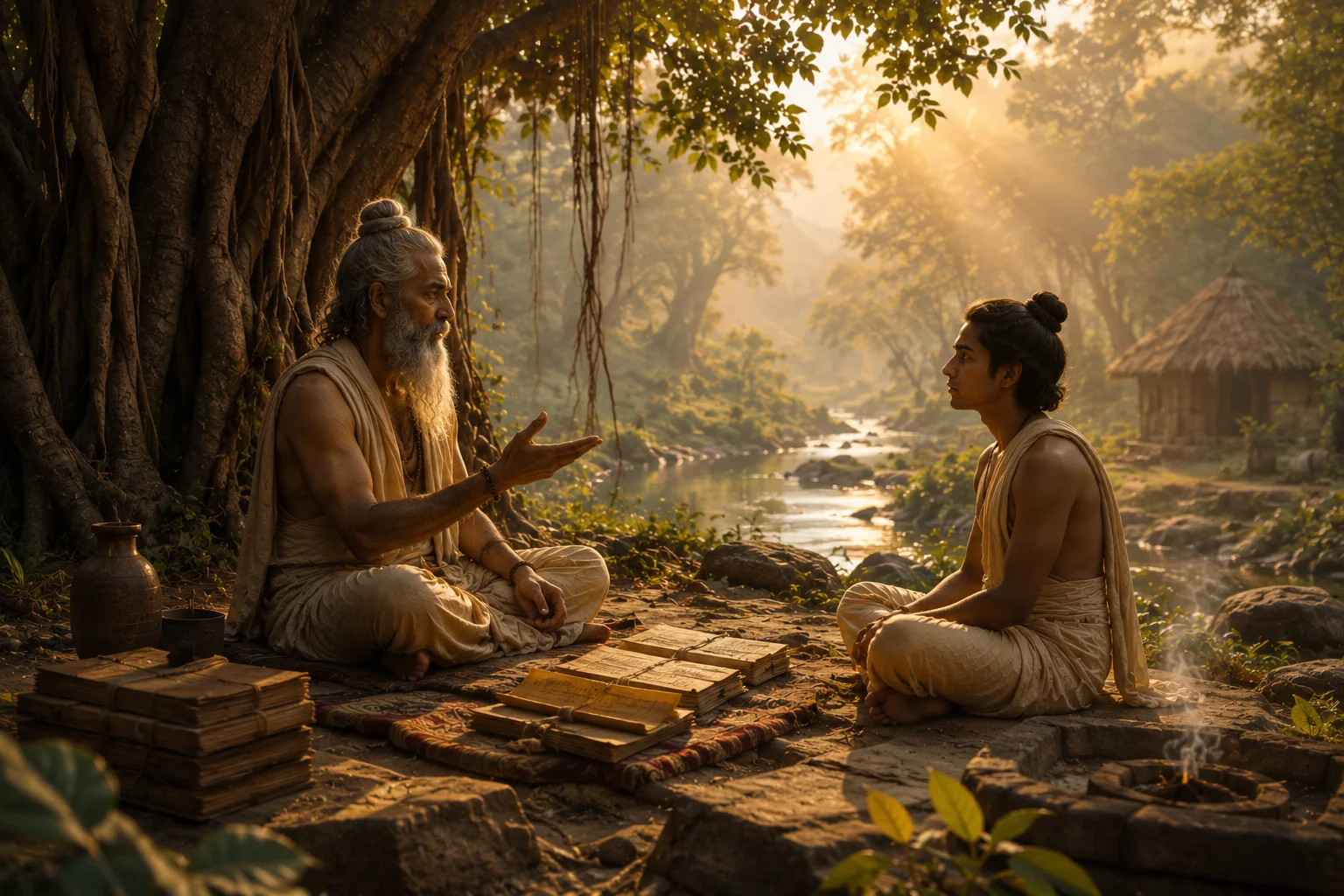
A boy named Nachiketa is given away by his father to Death.
The father, Vajashravasa, has been performing a great sacrifice, giving away his possessions as the ritual requires. But the cattle he is offering are old and barren, animals that have already given everything they had. The boy notices. He asks his father, more than once, to whom he himself will be given.
His father, irritated, says: to Death.
So Nachiketa goes. He arrives at the house of Yama, lord of the dead, and finds it empty. He waits three days without food or water. When Yama returns and discovers a brahmin guest has gone unattended in his house, he offers three boons in compensation.
The first two Nachiketa spends sensibly. With the third, he asks what happens to a person after death.
Yama tries to talk him out of it. He offers wealth, long life, sons and grandsons, horses, elephants, the pleasures of the world. Nachiketa refuses all of it, and says the thing that makes the Katha Upanishad worth reading twenty-eight centuries later: those pleasures wear out the senses, and even the longest life is short.
He wants the answer.
Sitting Down Near
The word Upanishad is usually parsed as upa (near), ni (down), shad (to sit). Sitting down near, in the sense of a student sitting close to a teacher for instruction that is not meant for a crowd.
There are around two hundred texts bearing the name. Thirteen are conventionally treated as principal, and the two oldest, the Brihadaranyaka and the Chandogya, are usually dated to roughly 800 to 600 BCE, which places them before the Buddha.
They are also called Vedanta, the end of the Vedas. The phrase carries both meanings: these texts come at the close of the Vedic corpus, and they represent its conclusion in the sense of its culmination.
What Changed
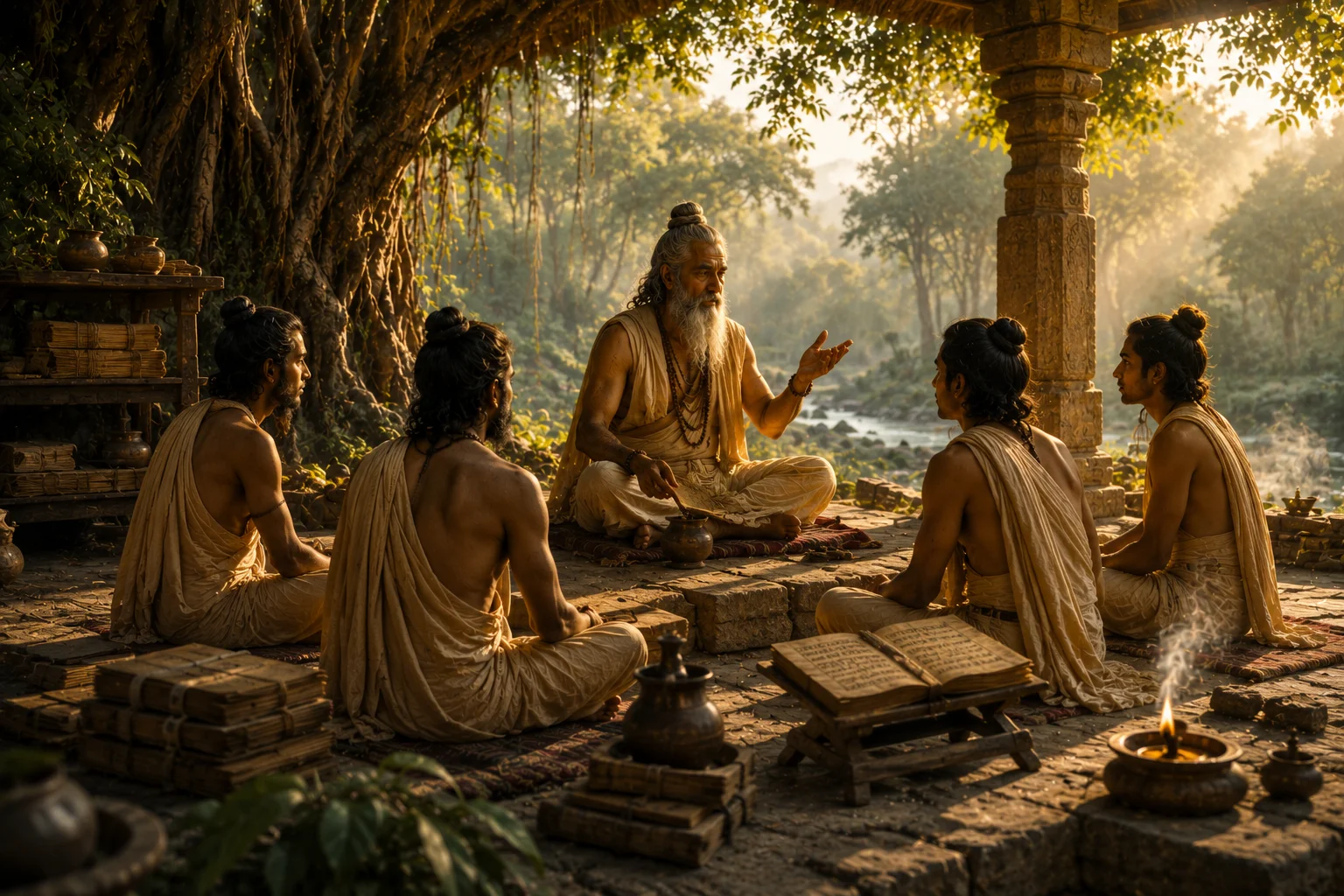
The shift from Vedic religion to Upanishadic thought is one of the genuine turning points in the history of ideas, and it can be stated simply.
The Vedas ask how to perform the sacrifice correctly. The Upanishads ask who is performing it.
The altar moves inward. Ritual is not rejected outright, but it is relativised, and in places treated with something close to impatience. The Mundaka Upanishad compares sacrifices to leaky boats. What matters instead is knowledge, and specifically knowledge of two things.
Brahman. The ground of reality, the absolute, that from which everything arises and into which it returns.
Atman. The self. Not the personality, not the body, not the stream of thoughts, but the awareness underneath all of those.
And then the claim that makes the whole tradition move: these two are not different.
The Chandogya Upanishad states it in one of the most quoted phrases in Indian philosophy, tat tvam asi, that thou art. The Brihadaranyaka puts it from the other direction, aham brahmasmi, I am Brahman.
Uddalaka and the Salt
The Chandogya illustrates the point in a scene between a father, Uddalaka, and his son Svetaketu, who has returned from twelve years of study rather pleased with himself.
Uddalaka asks him to put a lump of salt into a container of water and leave it overnight. In the morning he asks the boy to retrieve it. The boy cannot; it has dissolved.
Taste the water at the top, the father says. Salty. The middle. Salty. The bottom. Salty.
The salt is not gone. It is not in one place either. It has become the water throughout, present everywhere and findable nowhere, and that, Uddalaka tells him, is the nature of the subtle essence that pervades everything.
It is a teaching method rather than an argument, and it works on people who have never read a word of philosophy.
Where Yoga Actually Enters
The Katha Upanishad, the text Nachiketa’s story belongs to, contains what many scholars regard as the earliest clear use of yoga in its later spiritual sense.
It describes yoga as the firm holding steady of the senses, and it warns that this state is not permanent. It comes and it goes.
The same text gives the image that has anchored the tradition ever since. The body is a chariot. The senses are the horses. The mind is the reins. The intellect is the charioteer. And the self is the passenger, who is not driving, who is not the vehicle, and who arrives nowhere at all if the charioteer is careless and the horses are allowed to run.
Anyone who has sat down to meditate and watched their attention bolt in five directions will recognise the diagnosis.
The Shvetashvatara Upanishad, somewhat later, goes further and becomes explicitly practical. It advises holding the body straight with chest, neck and head aligned, restraining the breath, and choosing a place for practice that is level, clean, quiet and protected from wind.
That is recognisably instruction. It is roughly the shape of what Patanjali would later systematise.
Gargi Asks Twice
The Brihadaranyaka contains a scene worth knowing for reasons beyond philosophy.
King Janaka convenes a debate and offers a prize to whoever proves the greatest theologian. The sage Yajnavalkya simply claims the cattle at the outset, which does not go down well, and is then challenged by a series of scholars.
One of them is Gargi Vachaknavi. She questions him about what everything is woven upon, and when he answers, she pushes further and asks what that is woven upon. She does this repeatedly, driving the regress backward until Yajnavalkya tells her, in effect, not to ask beyond a certain point or her head will fall off.
She stops. Then she returns later with two more questions, framed as arrows, and gets her answer.
Gargi is among the earliest named women philosophers anywhere in the surviving record, and the text does not present her as an exception requiring explanation. She is simply in the room, and she is the one who pushes hardest.
The Long Reach
In 1801 a French scholar, Anquetil-Duperron, published a Latin translation of a Persian version of fifty Upanishads.
Arthur Schopenhauer got hold of it and never really recovered. He described it as the consolation of his life and said it would be the consolation of his death. Through him the texts reached the German Romantics, and through them, in time, Emerson and Thoreau in New England.
Which is a strange journey for a set of Sanskrit dialogues about the self: Sanskrit to Persian to Latin to German philosophy to American transcendentalism, and then eventually back to India, where nineteenth-century reformers encountered their own tradition partly refracted through European enthusiasm for it.
What Nachiketa Was Told
Yama does eventually answer.
The self, he says, is not born and does not die. It did not come from anywhere and is not going anywhere. Smaller than the small, greater than the great, it is not reached by argument, or by learning, or by the intellect working hard at it.
Whether that satisfies as an answer depends entirely on what you brought to the question.
But notice what the text does with a boy who was thrown away by a careless father. It does not rescue him or restore him to his family. It gives him the one thing he asked for and takes seriously the possibility that he was right to want it more than horses.
Common Questions
What are the Upanishads?
A body of Sanskrit philosophical texts, around two hundred in total with thirteen principal ones, marking the shift from Vedic ritual toward enquiry into consciousness and the self.
How old are they?
The oldest, the Brihadaranyaka and Chandogya, are generally dated to roughly 800 to 600 BCE, placing them before the Buddha.
What does tat tvam asi mean?
That thou art. It appears in the Chandogya Upanishad and asserts the identity of the individual self, atman, with ultimate reality, brahman.
Do the Upanishads discuss yoga?
Yes. The Katha Upanishad contains what is often considered the earliest clear use of the word in its spiritual sense, and the Shvetashvatara gives practical instruction on posture, breath and place of practice.
Why are they called Vedanta?
Vedanta means the end of the Vedas, in both senses: they come at the close of the Vedic corpus and are regarded as its culmination.
What is the chariot metaphor? From the Katha Upanishad: the body is a chariot, the senses are horses, the mind is the reins, the intellect is the charioteer, and the self is the passenger.
Sources consulted: The Principal Upanishads, S. Radhakrishnan; Patrick Olivelle, Upanisads (Oxford World’s Classics); Encyclopaedia Britannica, “Upanishad”; Katha and Chandogya Upanishads, standard translations.
Sources and further reading
Primary texts are linked in public-domain translations where one exists; modern scholarship is linked to the publisher.
- The Thirteen Principal Upanishads, translated by Robert Ernest Hume
- The Upanishads, Sacred Books of the East vol. 1, translated by Max Muller
- Patrick Olivelle, Upanisads (Oxford World’s Classics)
- Encyclopaedia Britannica, Upanishad
- Light on Yoga, 1966: The Book That Standardised the Poses
- The Yoga Vasistha: The Longest Argument That Nothing Is Happening
- The Hatha Yoga Pradipika: How a Fifteenth-Century Compilation Became the Standard
- The Amritasiddhi: The Oldest Hatha Text Is Not What Anyone Expected
- The Samkhya Karika: The System Yoga Is Built On

Leave a Reply