

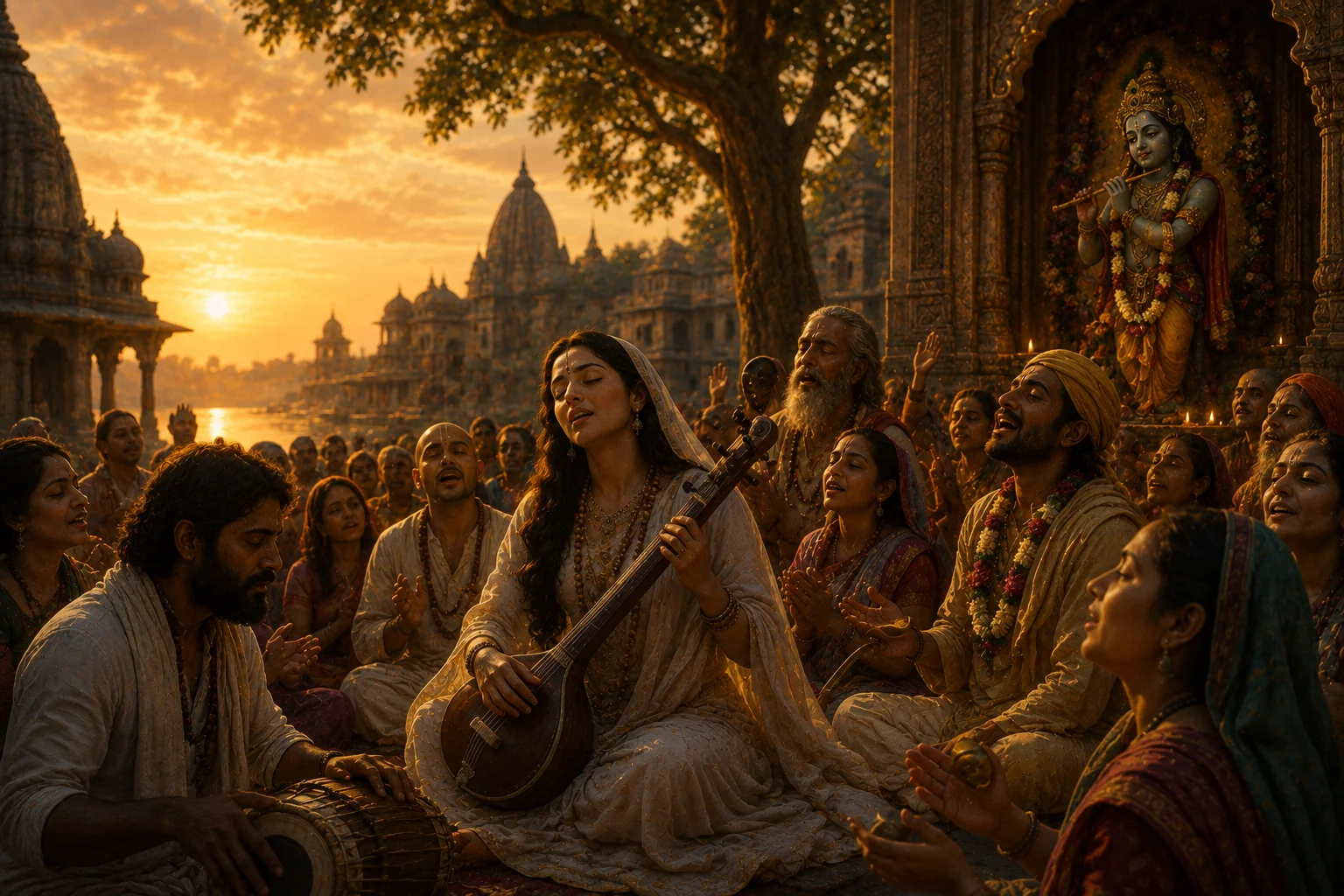
Kabir was a weaver.
Ravidas worked leather, an occupation that placed him at the bottom of the social order. Tukaram sold groceries. Namdev was a tailor. Mirabai was a Rajput princess who walked out of a palace. Andal was a girl in ninth-century Tamil country who wrote thirty verses and refused to marry any human being.
None of them were brahmins. Most did not write in Sanskrit.
Between roughly the sixth century and the seventeenth, they and hundreds like them produced a body of devotional poetry that reorganised Indian religious life from below.
That movement is the historical substance of bhakti yoga, and it is considerably more interesting than the definition.
The Word
Bhakti comes from the root bhaj, to share, to partake, to belong to. The usual translation is devotion, which catches the feeling and misses the mutuality.
As a path, bhakti yoga is the discipline of directing love toward the divine and offering everything through that relationship. The Bhagavad Gita gives it a full chapter, and in chapter 12 has Krishna say that those who worship with steady love are dearest to him.
The Gita makes a claim with substantial consequences. This path is available to anyone, regardless of learning, birth or ritual qualification.
Several centuries later, people took that seriously.
It Starts in the South
Bhakti as a mass phenomenon begins in Tamil country between roughly the sixth and ninth centuries, with two groups of poet-saints.
The Alvars, twelve poets devoted to Vishnu. One, Andal, was a woman. Her Tiruppavai, thirty verses composed as a young girl, is still recited daily in Tamil households during the month of Margazhi.
The Nayanars, sixty-three poets devoted to Shiva, whose hymns were collected and set to music.
What both groups did was decisive, and it can be stated in three parts.
They sang in Tamil rather than Sanskrit. They performed in public, in temples and processions and streets, rather than at restricted rituals. And they framed the relationship with the divine in intensely personal terms. As lover. As parent. As child. As friend. As servant.
Religion moved from a transaction conducted by specialists to a relationship conducted by anybody.
Northward, Slowly
The movement travelled north across roughly eight hundred years, taking a different form in each region and each language.
| Figure | Period | Region | Contribution |
| Ramanuja | 1017 to 1137 | Tamil Nadu | Gave bhakti a rigorous philosophical foundation |
| Basava | c. 1105 to 1167 | Karnataka | Founded the Lingayat movement, rejecting caste and temple ritual |
| Jnaneshwar and Namdev | 1275 to 1350 | Maharashtra | Marathi devotional poetry, the Varkari tradition |
| Kabir | c. 1440 to 1518 | North India | Weaver, critic of both Hindu and Muslim orthodoxy |
| Guru Nanak | 1469 to 1539 | Punjab | Founder of Sikhism, in dialogue with bhakti currents |
| Chaitanya | 1486 to 1534 | Bengal | Ecstatic devotion to Krishna, congregational singing |
| Mirabai | c. 1498 to 1547 | Rajasthan | Princess turned wandering devotee of Krishna |
| Tulsidas | c. 1532 to 1623 | North India | Ramcharitmanas, the Ramayana in Awadhi |
| Surdas | c. 1478 to 1583 | North India | Braj poetry on Krishna’s childhood |
Vernacular composition runs through all of it. Tulsidas retelling the Ramayana in Awadhi rather than Sanskrit put the story into the mouths of people who could never have read it otherwise. It is still recited across northern India.
What It Did
The bhakti poets were not running a reform programme with a manifesto. Many were entirely uninterested in social organisation and wanted only their god.
The effect happened regardless.
If devotion is what counts, and devotion is available to a weaver and a leatherworker and a woman who left her husband’s household, then the apparatus of ritual qualification loses its monopoly.
Kabir attacked religious formalism on both sides with a directness that still reads as startling. Basava’s community rejected caste distinction and temple brahminism outright.
The resistance was real. By tradition, Mirabai’s family tried repeatedly to kill her. Bhakti figures were harassed, excluded and occasionally worse.
None of this dismantled the caste system. Claiming it did would be false.
What it created was a counter-current. It had its own literature. It had its own saints and its own authority. It ran underneath the orthodox structures, and it was never fully absorbed by them.
Giving It a Philosophy
Devotional feeling on its own does not survive contact with trained philosophers. Somebody had to make the case in their language.
Ramanuja did it, across a life running from 1017 to 1137.
The dominant school at the time was Shankara’s non-dualism, which held that the individual self and ultimate reality are finally identical, and that all distinction is provisional. That position is difficult for a devotee. If there is no real difference between you and the divine, there is nobody to love.
Ramanuja argued for a modified position. The self is real. The divine is real. They are distinct, and yet the self depends on the divine completely, the way a body depends on the person animating it.
That gave bhakti a defensible metaphysics. Love needs two.
The Language of Love
The poetry itself is worth encountering rather than reading about.
Bhakti verse borrows wholesale from the vocabulary of human love, often from its most uncomfortable registers. The devotee waits. The devotee is ignored. The devotee is jealous, humiliated, sleepless, furious.
Mirabai writes as a woman who has taken Krishna as her husband. She abandoned every social obligation to do it.
The Tamil Alvars write as women pining for a lover who will not come.
Chaitanya’s Bengali tradition went furthest. It built a whole theology of separation, and treated longing itself as the highest state a devotee could reach.
None of this was decorative. Framing devotion as erotic and domestic love brought it into a world of feeling ordinary people already inhabited completely, with no priest required to mediate it.
Nine Ways In
The Bhagavata Purana, compiled around the ninth or tenth century, sets out navadha bhakti, nine forms devotion can take.
- Shravana, hearing about the divine
- Kirtana, singing
- Smarana, remembering
- Padasevana, service at the feet
- Archana, ritual worship
- Vandana, prostration
- Dasya, the attitude of a servant
- Sakhya, the attitude of a friend
- Atmanivedana, complete self-offering
The range is the point. Temperament determines the form. Somebody who cannot sit still in meditation can sing. Somebody who cannot articulate a theology can serve.
Why It Outlasted the Others
Of the four classical paths, bhakti became by far the most widely practised in India, and the reasons are practical.
Jnana yoga needs sustained analytical capacity. Historically it also needed access to texts, which most people did not have.
Raja yoga needs long hours of disciplined solitude.
Karma yoga needs a subtle inner shift. It is easy to describe and hard to sustain.
Bhakti requires that you love something.
That is not a lower bar in the sense of being easier. Mirabai gave up a kingdom, and the poetry of the movement is full of unbearable longing rather than comfort. But it is a bar almost anybody can approach, from wherever they happen to be, without permission from anyone.
Andal wrote her thirty verses and, by tradition, refused every human suitor. She would have been about sixteen.
Twelve hundred years later, people in Tamil Nadu still wake before dawn in Margazhi to recite them.
Bhakti Yoga: Reader Questions
What is bhakti yoga?
The path of devotion, in which love directed toward the divine becomes the primary spiritual practice. One of the four classical paths of yoga.
What does bhakti mean?
From the Sanskrit root bhaj, to share or partake. Usually translated as devotion, though the original carries a stronger sense of belonging.
When did the bhakti movement begin? In Tamil country between roughly the sixth and ninth centuries, with the Alvar and Nayanar poet-saints, spreading north over the following eight hundred years.
Who were the main bhakti saints?
Among many: Andal, Ramanuja, Basava, Jnaneshwar, Namdev, Kabir, Mirabai, Chaitanya, Tulsidas and Surdas.
Why was the movement socially significant?
Its poets wrote in regional languages rather than Sanskrit, many came from outside brahmin communities, and the path required no ritual qualification.
What are the nine forms of devotion?
Hearing, singing, remembering, service, worship, prostration, servitude, friendship and complete self-offering, from the Bhagavata Purana.
Did bhakti end the caste system?
No. It created a lasting counter-current with its own saints and authority, but it did not dismantle the structure it operated underneath.
Sources consulted: A. K. Ramanujan, Speaking of Siva (1973) and Hymns for the Drowning (1981); John Stratton Hawley, A Storm of Songs (2015); Barbara Stoler Miller’s translation of the Bhagavad Gita.
Sources and further reading
Primary texts are linked in public-domain translations where one exists; modern scholarship is linked to the publisher.
Leave a Reply