

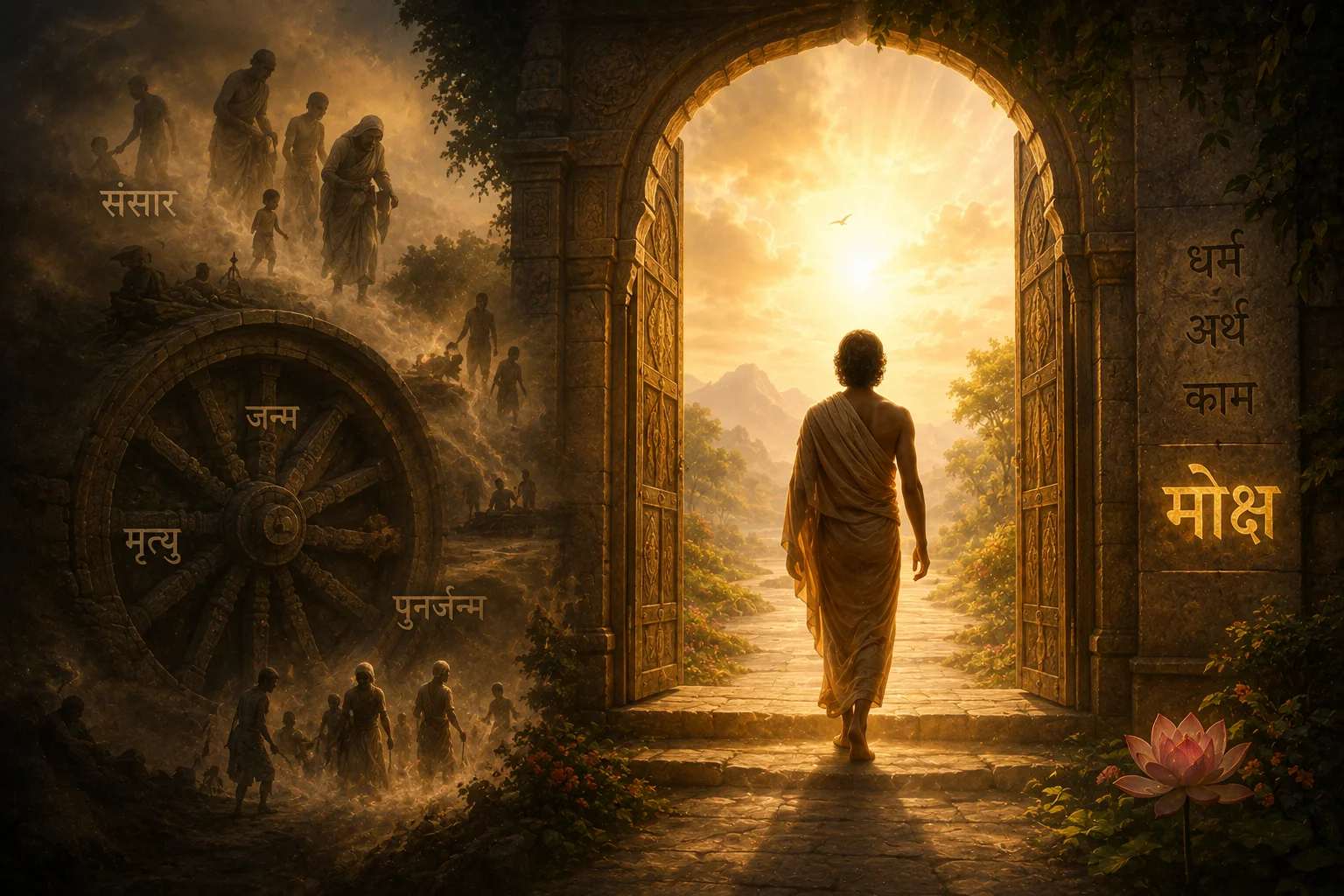
Ask what yoga is for and most modern answers describe a better version of the life you already have. Calmer. Healthier. More focused.
The tradition’s own answer is that yoga is for getting out.
The Problem It Solves
Moksha means release. It comes from the root much, to free or let go, and it is one of a cluster of related terms: mukti, liberation, kaivalya, aloneness, and nirvana in Buddhist usage.
What it releases you from is samsara.
Samsara is usually translated as the cycle of rebirth, which is accurate and incomplete. The word means wandering or flowing through. It describes an endless sequence of births, deaths and rebirths, driven by karma, in which a being moves between conditions without ever arriving anywhere.
The critical point, and the one most easily missed by readers raised in other traditions, is that this is not presented as an opportunity.
Indian philosophy overwhelmingly treats samsara as a problem. Not a gift of multiple lives, but a trap. Even a fortunate rebirth ends, and the whole thing begins again.
Moksha is the exit.
Four Aims, One Final
Classical Indian thought organises human life around four legitimate goals, the purusharthas.
Dharma, duty and righteous conduct. Artha, material prosperity and security. Kama, pleasure and desire, including but not limited to the erotic. Moksha, liberation.
The first three are not condemned. This is worth emphasising, because ascetic traditions are often assumed to reject worldly life outright. The framework explicitly permits ambition, wealth and pleasure, provided they are pursued within dharma.
Moksha sits apart from the other three. It is not more of the same. It is the goal that ends the pursuit of goals.
Where the Schools Disagree
Every major Indian tradition accepts moksha as the aim and disagrees sharply about what it consists of.
Advaita Vedanta, following Shankara around 700 to 750 CE, holds that moksha is recognition. The self was never separate from Brahman. Bondage was a misapprehension, not a condition, so liberation is not something acquired. It is something noticed.
Vishishtadvaita, following Ramanuja, 1017 to 1137, holds that the self remains real and distinct after liberation, in an eternal relationship of dependence and love with the divine. Union without dissolution.
Dvaita, following Madhva, 1238 to 1317, holds that the difference is permanent. The liberated self enjoys the divine presence forever, and remains itself.
Samkhya and Patanjali’s yoga describe kaivalya, aloneness. Consciousness is disentangled from matter and rests in its own nature. Note that this is not union with anything. It is closer to separation, which sits awkwardly with the popular definition of yoga as union.
Jainism holds that the liberated soul rises to the top of the universe and remains there in omniscient bliss, having shed all karmic matter.
Buddhism rejects the permanent self the others are trying to liberate, and describes nirvana as the extinguishing of craving rather than the freeing of a soul.
Five positions, all serious, all defended across centuries. Anyone claiming a single Indian view of liberation is flattening a very long argument.
Liberation While Alive
One idea deserves separating out, because it changes what the goal looks like in practice.
Jivanmukti means liberated while living. It holds that moksha need not wait for death. A person can attain it and then continue to live, eat, teach and grow old in an ordinary body.
The jivanmukta still experiences hunger and pain. What has ended is the identification that made those experiences the property of a separate self with something at stake in them.
Advaita accepts this readily. Some other schools do not, holding that liberation is complete only at death, a state called videhamukti.
The distinction matters because it determines whether the tradition is describing a possible human condition or a posthumous reward.
How Karma Fits
Karma is the mechanism keeping samsara running, and moksha requires the mechanism to stop.
Actions leave impressions. Impressions produce tendencies. Tendencies produce further action, and the accumulated momentum carries a being into another birth.
Note that good karma is not an escape route. A virtuous life produces a better rebirth, which is still a rebirth, and the wheel keeps turning.
This is why the Bhagavad Gita’s teaching on action matters so much. Krishna’s instruction is not to stop acting but to act without craving results, because it is the craving that generates the binding impression rather than the action itself.
Act without attachment and, in this framework, you can act indefinitely without accumulating anything that requires another life to work out.
What It Would Be Like
The texts are cautious here, and the caution is not evasion.
Descriptions of moksha are almost entirely negative. Free from sorrow. Free from fear. Free from birth and death. Beyond the reach of grief. Not this, not this.
Where positive language appears it tends towards the formula sat-chit-ananda, being, consciousness, bliss. Even that is usually presented as pointing at something rather than describing it.
The reasoning is consistent with everything else in the tradition. A state in which the separate experiencer has dissolved cannot be described from the outside, and there is no inside from which a report could be sent.
Who Was It For
A question worth asking is who the classical tradition thought could actually attain this.
The answer, for much of the historical period, was restrictive. Access to Vedic study was limited by birth and by gender, and moksha was widely treated as available to renunciates, meaning people who had formally left household life.
That exclusion is precisely what the bhakti movement pushed against from roughly the sixth century onward, insisting that devotion required no ritual qualification. It is also what the Bhagavad Gita opens up, by arguing that action performed without attachment counts as fully as withdrawal.
The history of moksha is partly a history of an argument about who was allowed to want it.
The Gap Between Then and Now
Modern yoga rarely mentions any of this.
A studio class offers stress reduction, flexibility, strength and calm. Those are real benefits and the tradition would not deny them. Hatha texts list physical results freely.
But the goal has quietly changed. The classical texts are describing an exit from existence as ordinarily experienced. Modern practice usually offers an improvement to it.
None of which is a scandal. Traditions adapt, and a practice that makes people calmer is doing something worth doing.
It is only a problem when the modern goal is presented as the ancient one. The people who wrote these texts were not trying to help anybody sleep better. They were trying to get out, permanently, and they did not expect it to take one lifetime.
Moksha: Reader Questions
What is moksha? Liberation from samsara, the cycle of birth, death and rebirth. It is the final goal of most Indian philosophical traditions.
How is moksha different from nirvana? Both describe liberation, but Buddhism rejects the permanent self that Hindu traditions seek to free, and describes nirvana as the extinguishing of craving.
What are the four aims of life? Dharma, righteous conduct. Artha, prosperity. Kama, pleasure. Moksha, liberation. The first three are legitimate pursuits within dharma.
Can you attain moksha while alive? Some schools say yes, describing it as jivanmukti, liberated while living. Others hold that liberation is complete only at death.
Does good karma lead to moksha? Not directly. Good karma produces a better rebirth, which is still a rebirth. Liberation requires ending the accumulation rather than improving it.
Why do the schools disagree about moksha? Because they disagree about what the self is. Advaita treats liberation as recognition of non-duality, while dualist schools hold that the self remains distinct.
Sources consulted: The Principal Upanishads, S. Radhakrishnan; Eliot Deutsch, Advaita Vedanta: A Philosophical Reconstruction (1969); Barbara Stoler Miller’s translation of the Bhagavad Gita; Edwin Bryant, The Yoga Sutras of Patañjali (2009).
Sources and further reading
Primary texts are linked in public-domain translations where one exists; modern scholarship is linked to the publisher.
Leave a Reply