
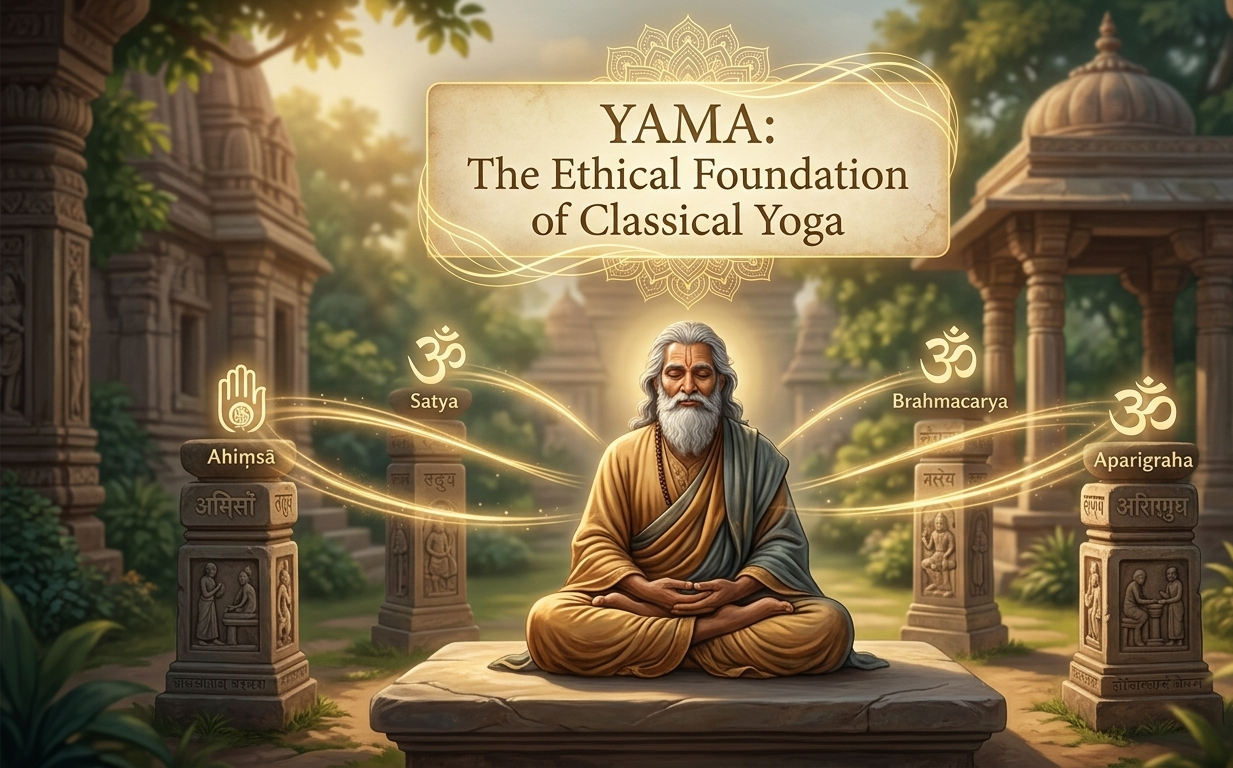
When we study the history of Yoga, especially through the lens of the Yoga Sutras, one thing becomes very clear. Yoga was never designed to begin with the body. It began with character. It began with discipline of behavior. It began with Yama.
In the classical system of Ashtanga Yoga described by the sage Patanjali around the early centuries BCE or CE, Yama is the very first limb. Before posture. Before breath control. Before meditation. This historical order itself tells us something important. In ancient Indian thought, inner clarity could not be achieved without ethical stability.
Yama can be understood as universal moral restraints. These were not rules imposed by society. They were disciplines meant to purify the practitioner’s relationship with the world. The early yogic tradition believed that a disturbed social life creates a disturbed mind. And a disturbed mind cannot meditate deeply.
There are five Yamas described in the Yoga Sutras.
Table of Contents
Toggle1. Ahimsa: Non Violence
Ahimsa is often translated as non violence, but historically its meaning was much deeper than simply avoiding physical harm. In ancient Indian philosophy, violence included harsh speech, harmful thoughts, and exploitation.
Ahimsa required the yogi to cultivate gentleness in action and intention. It reflected a broader cultural idea present in Indian traditions, including Jainism and Buddhism, where non violence became a central principle of life.
The historical significance of Ahimsa is immense. It shaped not only spiritual practice but also social ethics across centuries.
2. Satya: Truthfulness
Satya means truthfulness. But again, this was not limited to speaking facts. In classical Yoga, Satya meant alignment between thought, speech, and action. It meant living in authenticity.
Ancient Indian philosophers believed that truth was not merely moral. It was ontological. Truth reflected reality itself. Therefore, speaking falsehood was seen as distancing oneself from reality.
Within yogic history, Satya reinforced clarity of mind. A person who deceives others ultimately deceives themselves, and such confusion obstructs meditation.
3. Asteya: Non Stealing
Asteya means non stealing. Historically, this extended beyond material theft. It included taking credit that does not belong to you, exploiting others’ time, or desiring what is not rightfully yours.
In ancient India, where ascetic communities depended on public trust, Asteya was essential. A yogi who violated trust weakened not only personal practice but the entire spiritual order.
Asteya encouraged contentment and discipline. It restrained greed, which was seen as a major cause of mental agitation.
4. Brahmacharya: Moderation of Energy
Brahmacharya is often misunderstood. While it is sometimes translated as celibacy, its original meaning was broader. It referred to the wise use of vital energy.
In the historical context of Yoga, Brahmacharya meant self control in all pleasures, not only sexual restraint. It encouraged balance rather than suppression. The belief was that scattered energy weakens concentration, while conserved energy strengthens awareness.
Many ascetic traditions in India emphasized Brahmacharya as essential for deep meditation.
5. Aparigraha: Non Possessiveness
Aparigraha means non hoarding or non possessiveness. Ancient yogis observed that attachment to possessions creates fear of loss. Fear disturbs the mind.
In a historical context where renunciation was common among seekers, Aparigraha supported simplicity. The less one accumulated, the freer one felt.
This principle also reflected a broader Indian cultural respect for minimalism and detachment.
Historical Importance of Yama
Yama was not optional in classical Yoga. It was foundational. Patanjali even described these restraints as universal vows, applicable regardless of time, place, or social status.
This universality shows that early Yoga was not only a spiritual path but also a social philosophy. It aimed to harmonize individual conduct with collective well being.
Without Yama, later limbs such as concentration and meditation were considered unstable. Ethical confusion would disturb mental clarity.
Historically, Yama connects Yoga to the larger moral frameworks of Indian civilization. It reveals that Yoga was never just physical discipline. It was a comprehensive approach to living responsibly and consciously.
Understanding Yama helps us see that the roots of Yoga lie not in flexibility, but in integrity
Also Read: The Late Medieval Period: Decline, Preservation, and the Quiet Guardians of Yoga