
By the late nineteenth century, Yoga stood at a delicate moment in its long history. It had survived thousands of years, but it was no longer widely understood, even in its own land. For many Indians living under colonial rule, Yoga appeared distant and fragmented. Some associated it only with extreme ascetics, others with ritual practices stripped of their original philosophical depth. The everyday connection between Yoga and Indian intellectual life had weakened.
At the same time, India itself was undergoing a deep transformation. Western education systems were reshaping how knowledge was valued. Ancient Indian traditions were often labeled unscientific or obsolete. Sanskrit learning declined, and with it, direct access to classical yogic texts. Yoga did not disappear, but it existed in pockets, practiced by monks, householders, and small lineages rather than the broader society.
Yet this period of uncertainty also became the ground for revival.
Table of Contents
ToggleA Cultural Awakening and Return to the Texts
The late nineteenth century saw the rise of Indian thinkers who began questioning the dismissal of their own heritage. They asked an important question. If India had produced such vast philosophical systems in the past, why should those systems be ignored now.
This questioning led to a renewed study of ancient texts. The Upanishads, the Yoga Sutras, and classical Hatha Yoga manuals were revisited with fresh eyes. Yoga was no longer approached only as religious belief, but as a disciplined method of understanding the mind, behavior, and human suffering.
This shift was crucial. Yoga was reframed as a system of self development rather than superstition. Concepts like concentration, restraint, breath control, and meditation were explained in clear, rational language. This made Yoga accessible to Indians educated in modern institutions, many of whom had grown distant from traditional learning.
Yoga began to find its voice again.
Public Teaching and the End of Secrecy
For centuries, Yoga had survived through secrecy and selective transmission. In the revival period, this changed. Teachers began to share yogic knowledge openly. Ashrams and learning centers emerged where Yoga was taught systematically rather than privately.
Texts were printed and distributed. Commentaries were written to explain difficult ideas in simpler terms. Yoga was no longer confined to forests or isolated monasteries. It entered towns, cities, and educational spaces.
This openness marked a major historical shift. Knowledge that had once been protected through silence was now preserved through documentation. This reduced the risk of loss and allowed Yoga to reach a wider audience than ever before.
Different interpretations developed during this time. Some schools emphasized discipline of the body. Others focused on meditation and philosophy. Rather than weakening Yoga, this diversity reflected its long evolutionary history.
Yoga Beyond India’s Borders
Another defining moment of this period was Yoga’s movement beyond India. Indian teachers presented Yoga to audiences outside the subcontinent, especially in Europe and America. What they presented was not ritual or cultural symbolism, but a universal philosophy of self control, awareness, and inner balance.
This exposure introduced Yoga to philosophers, scholars, and spiritual seekers who were dissatisfied with purely material explanations of life. Yoga was discussed alongside psychology, ethics, and philosophy. It was studied, debated, and admired.
Interestingly, this global interest also influenced how Yoga was viewed within India. When Indians saw their own tradition respected internationally, it encouraged renewed confidence and curiosity. Yoga began to reclaim its place as a source of intellectual and spiritual pride.
Yoga and the National Consciousness
As India moved closer to independence, Yoga became more than a personal discipline. It became a cultural symbol. In a time marked by political struggle and social change, Yoga represented inner strength, self discipline, and continuity with the past.
It reminded people that Indian civilization was not defined only by external power, but by inner inquiry. Yoga reinforced the idea that freedom was not merely political. It was also psychological and ethical.
This connection between Yoga and national identity helped ensure its survival during a time of transition. Yoga was no longer invisible. It was recognized as part of India’s living heritage.
Standing at the Edge of a New Chapter
By the mid twentieth century, Yoga had completed a full historical cycle. It had emerged in ancient times as a path of liberation. It had evolved through philosophy, Tantra, and physical discipline. It had endured destruction, neglect, and silence. And now, it stood renewed.
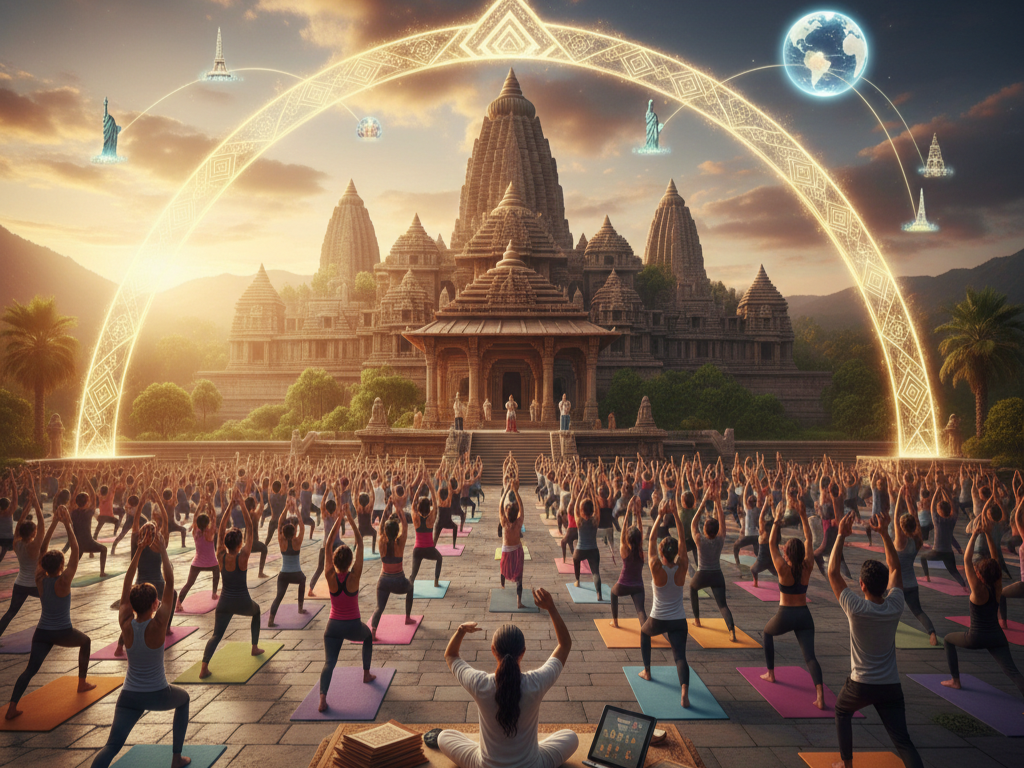
Yoga was no longer hidden. It was no longer fragmented. It was ready to enter a new phase of history, one in which it would become widely visible and globally practiced.
This moment was not the end of Yoga’s journey. It was a threshold. Everything that followed was built upon this revival.
Yoga had survived because it addressed something timeless. The human search for clarity, balance, and freedom. And as history shows, any knowledge rooted in that search never truly disappears.