
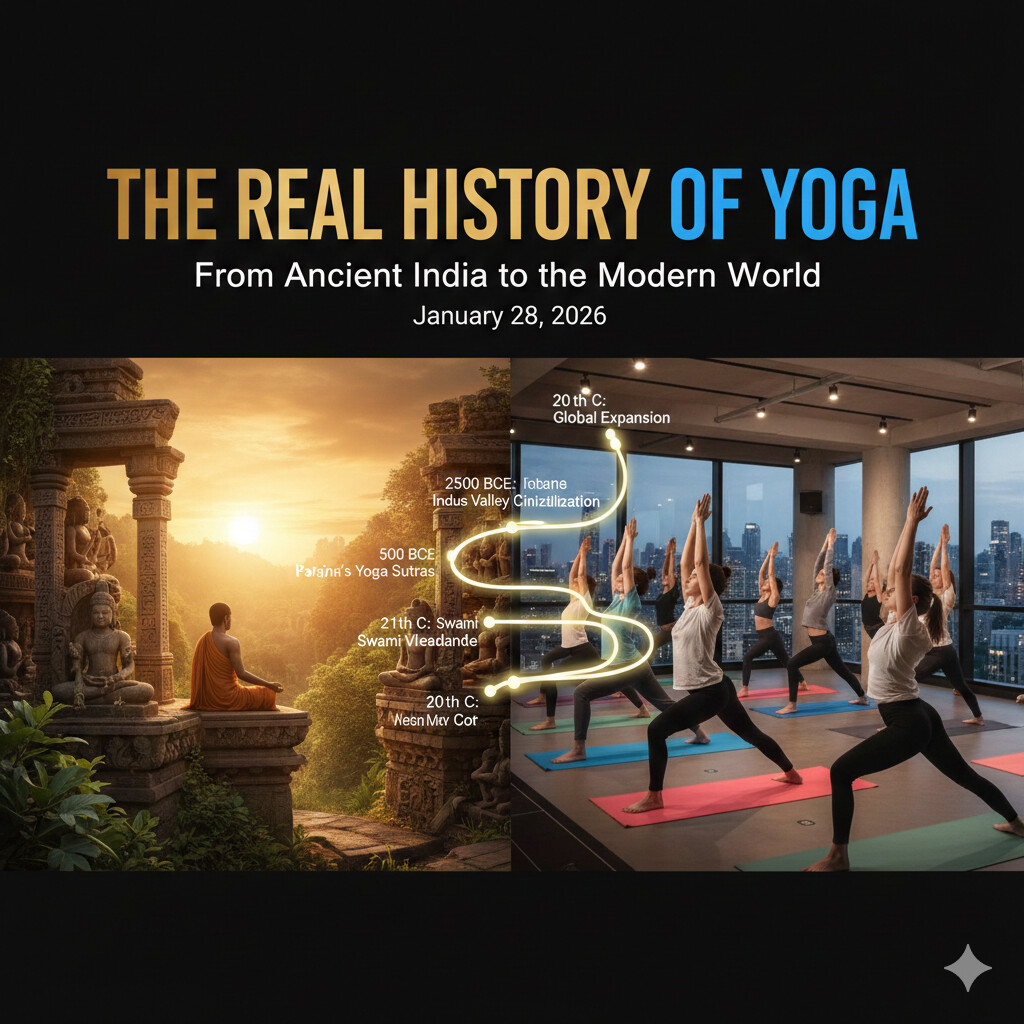
To be honest, for a long time I thought Yoga was just about stretching, breathing, and maintaining physical fitness. Morning parks, yoga mats, slow movements, and calm music. That was my entire understanding of it. But when I started exploring the real history of Yoga, especially through deep documentaries and ancient references, my perspective completely changed. Yoga is not a workout system. Yoga is a way of understanding life itself.
This blog is not just written to share information. It is written from a place of curiosity and respect. Because when we reduce Yoga to a fitness trend, we lose its soul. The real purpose of Yoga was never only to make the body flexible. Its purpose was to make the mind free.
Today, Yoga is a global industry. According to the Global Wellness Institute, the wellness economy crossed 5.6 trillion dollars in recent years, and Yoga contributes significantly through classes, retreats, teacher training, and wellness tourism. The Yoga market alone is valued at over 100 billion dollars globally. Yet, most people practicing Yoga today are not aware of where it truly came from or why it was created.
That gap between popularity and understanding is what inspired me to write this blog.
Here, I want to take you back in time. Not with complicated academic language, but in a simple, honest, human way. Just like one person sharing something meaningful with another.
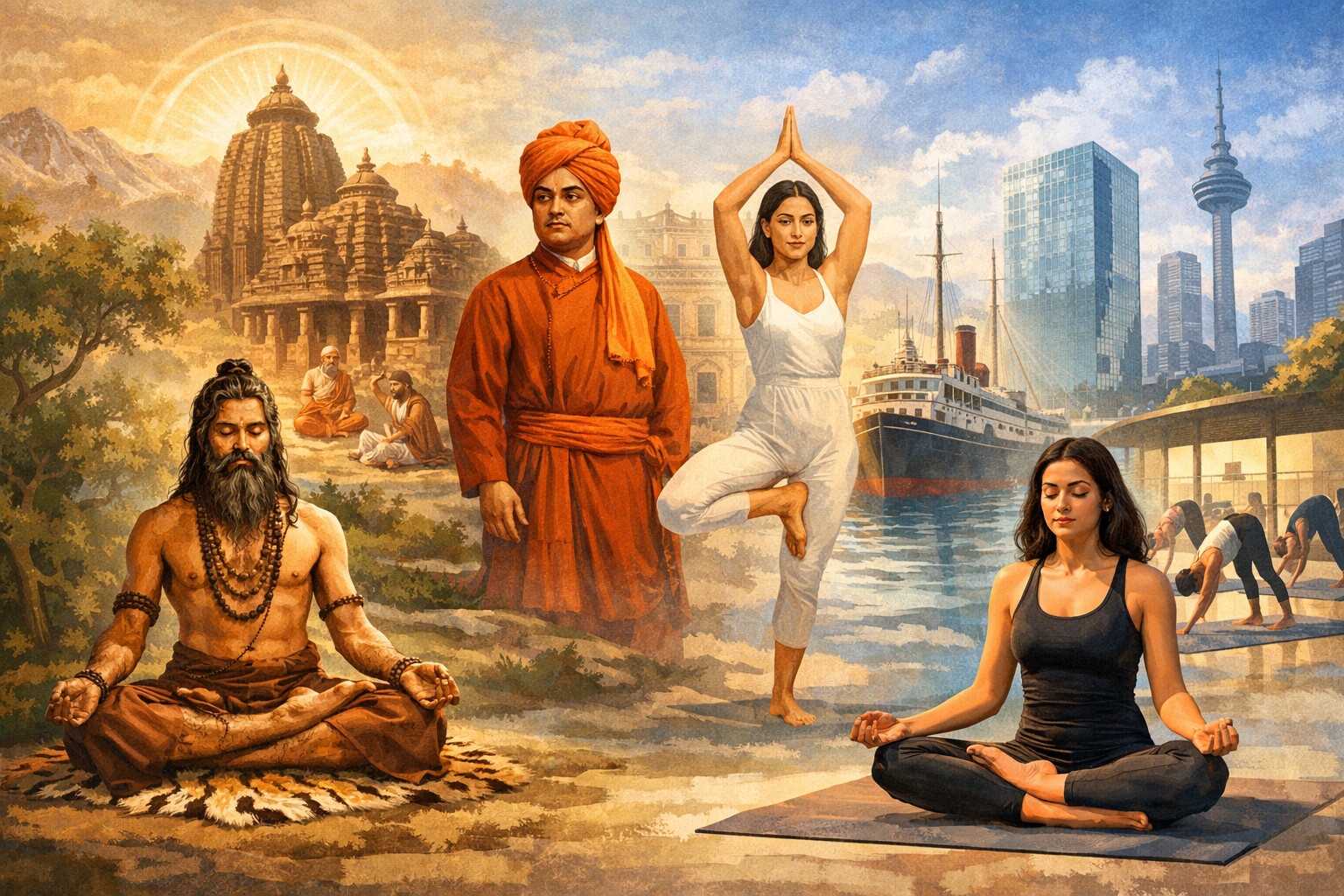
What Is Yoga Really
The word “Yoga” comes from the Sanskrit root “Yuj,” which means to unite or to join. But this union is not just physical. It is the union of mind, body, and awareness. It is the connection between your outer life and your inner self.
In ancient times, Yoga was a system to understand suffering, desire, fear, and attachment. It was a method to observe the mind and slowly rise above its chaos. Physical postures were only a small part of it. They existed to prepare the body for long periods of stillness and meditation.
Yoga was never about showing flexibility or strength. It was about clarity. It was about freedom from inner conflict.
That is why when ancient texts talk about Yoga, they rarely talk about poses. They talk about discipline, awareness, restraint, balance, and deep meditation.
The Origins of Yoga in Ancient India
Yoga is not a recent invention. Its roots go back more than 5,000 years, possibly even earlier. Archaeological evidence from the Indus Valley Civilization shows seals depicting figures in meditative postures. One famous seal shows a figure sitting in what looks like a yogic pose, often associated with Shiva as Pashupati.
While historians debate exact interpretations, these findings strongly suggest that meditation and yogic practices existed long before written scriptures.
Later, Yoga began to appear more clearly in the Vedas. The Rigveda, one of the oldest texts known to humanity, speaks about inner discipline, control of the mind, and cosmic order. Although Yoga was not systematized at this stage, its spiritual foundation was being built.
The Upanishads then took these ideas deeper. They explored questions like:
Who am I?
What is consciousness?
Why do we suffer?
How can we be free?
These questions became the heart of Yoga.
Yoga was not created for physical beauty or health trends. It was created because humans were searching for truth and peace.
Yoga as a Philosophy of Liberation
In ancient India, life was seen as a cycle of birth, death, and rebirth. This cycle was called Samsara. Yoga emerged as a path to break free from this cycle.
It taught that suffering comes from ignorance. From identifying too strongly with the body, thoughts, and emotions. Yoga trained people to observe rather than react. To witness rather than chase.
This is why Yoga is deeply connected to meditation. Without meditation, Yoga loses its depth.
Why This Matters Today
We live in a time of constant distraction. Notifications, deadlines, expectations, pressure. The ancient yogis were also surrounded by chaos, just in a different form. That is why Yoga still feels relevant.
Modern science now confirms what ancient Yoga masters already knew. Studies from institutions like Harvard Medical School and the National Institutes of Health show that Yoga and meditation help reduce anxiety, improve sleep, regulate blood pressure, and improve emotional balance.
Yoga is no longer just spiritual belief. It is supported by neuroscience and psychology.