
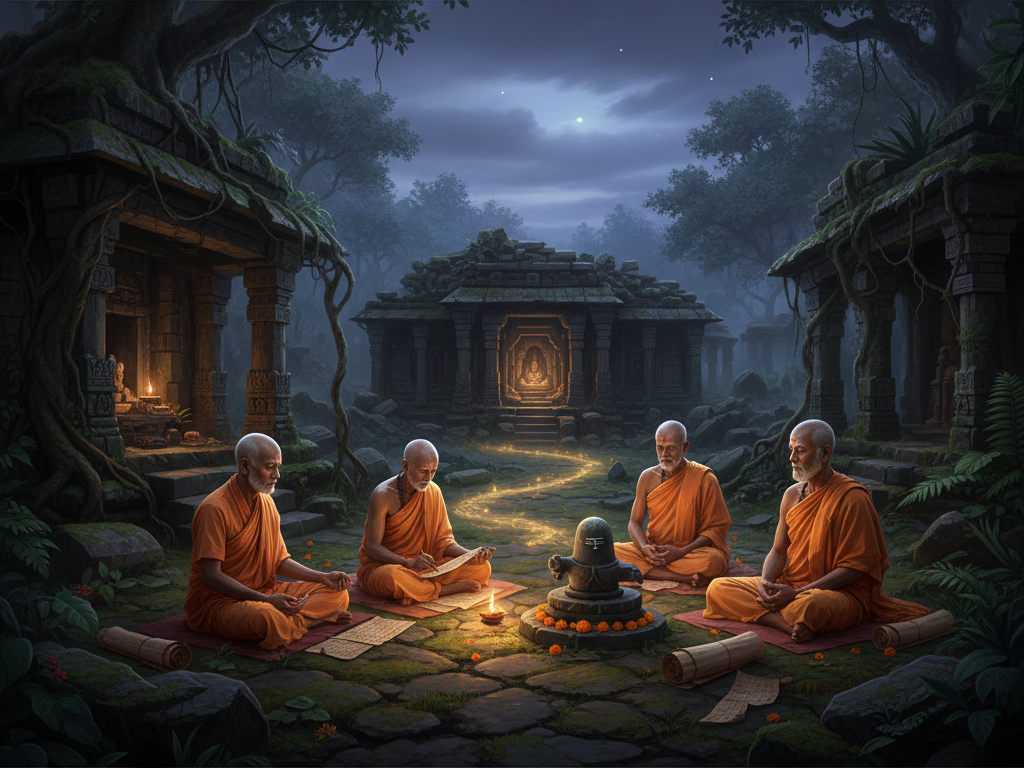
As centuries passed, India went through major political and social upheavals. Kingdoms rose and fell. Trade routes shifted. New belief systems arrived. With these changes, many ancient institutions that once supported yogic learning began to weaken. Large gurukuls declined. Royal patronage disappeared in many regions. Sacred spaces were damaged or abandoned.
This period is often described as a decline, but that would be an incomplete truth. Yoga did not disappear. It simply changed the way it survived.
Earlier, Yoga flourished openly in forests, monasteries, and temples. In the late medieval period, it became quieter. More personal. More hidden. Knowledge moved from public spaces into the hands of individual yogis, household practitioners, and small sects.
In the Indian tradition, when something becomes fragile, it does not fight loudly. It protects itself silently. Yoga did the same.
Yogis as Wanderers and Keepers of Knowledge
During this time, many yogis became wandering ascetics. They moved from village to village, forest to forest, carrying knowledge not in books, but in memory and practice. They taught selectively. Often only to those who showed discipline and sincerity.
This method protected Yoga. Written texts can be destroyed. Living knowledge is harder to erase.
Many yogic practices survived through oral transmission. Short verses. Symbols. Simple techniques that carried deep meaning. What could not be explained openly was encoded in poetry, ritual, and metaphor.
This is why many yogic texts from this period appear symbolic or cryptic. They were meant to be understood only by those already walking the path.
Regional Traditions and Folk Yoga
Another important development during this time was the spread of yogic ideas into regional and folk traditions. Yoga was no longer limited to Sanskrit scholars. It entered local languages, songs, and practices.
In villages, Yoga blended with daily life. Breath control, fasting, discipline, silence, and meditation became part of religious observance and seasonal rituals. Saints and mystics spoke in simple language so common people could understand deeper truths.
This period gave rise to a more accessible spirituality. Yoga moved closer to the masses, not through institutions, but through lived example.
This is why many Indian families, even today, carry small yogic habits without calling them Yoga. Silence during prayer. Controlled breathing. Early rising. Simple living. These are echoes of that era.
Preservation Through Texts and Lineages
Although much knowledge was transmitted orally, some important texts were preserved during this time. Works related to Hatha Yoga, Tantra, and meditation were copied, commented upon, and safeguarded by small communities.
Lineages became extremely important. A teacher was not just an instructor, but a guardian of tradition. Knowledge was passed carefully, often with strict discipline. This ensured purity of practice, even if the number of practitioners remained small.
This period taught Yoga resilience. It survived not through expansion, but through depth.
The Threshold Before the Modern Age
By the time India approached the early modern period, Yoga existed in fragments. Different schools. Different interpretations. Some focused on the body. Some on devotion. Some on meditation. But the core remained intact.
Yoga had not vanished. It had rested.
Waiting for a time when it could rise again, not as a secret tradition, but as shared knowledge.
That moment would come later, when Indian thinkers began to re examine their own heritage and present Yoga once again to the world.
Why This Phase Matters
This chapter of Yoga’s history is important because it reminds us of something deeply Indian. True knowledge does not need constant visibility. It survives through sincerity.
Yoga lived because someone practiced it quietly. Someone taught it honestly. Someone protected it without recognition.
That is how Yoga crossed centuries of uncertainty.
Not loudly.
Not forcefully.
But steadily.