
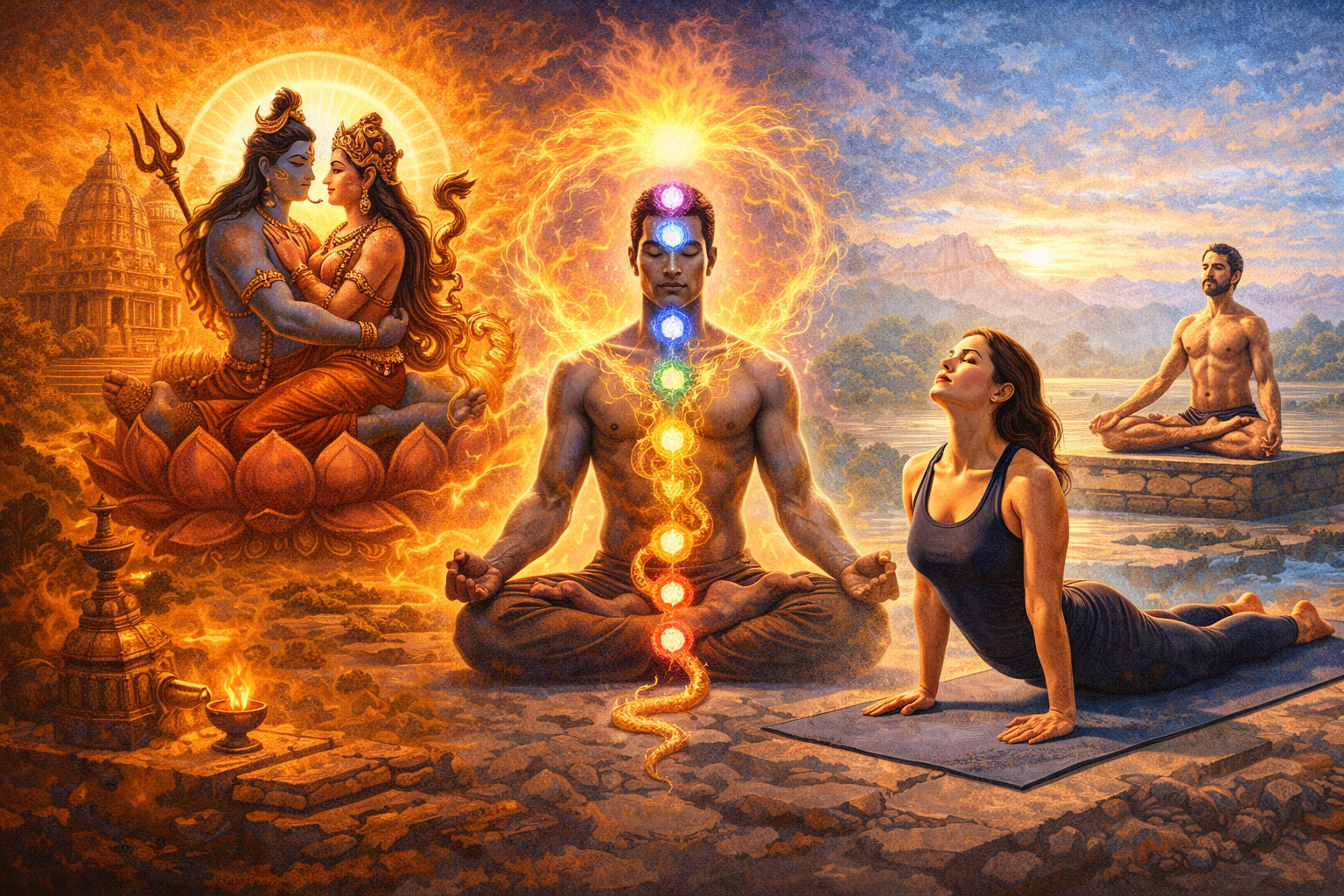
If the early period of Yoga was about exploration and spiritual searching, then Patanjali’s work was about structure. He did not invent Yoga. He organized it. He gave it a clear framework so that ordinary people could understand and practice it in a disciplined way.
Around 200 BCE to 400 CE, Patanjali compiled what we now know as the Yoga Sutras. It is a collection of 196 short statements. They are not stories or poems. They are direct instructions. Simple, powerful, and precise.
One of the most famous lines from the Yoga Sutras is:
“Yoga is the cessation of the fluctuations of the mind.”
In simple words, Yoga is about calming the constant noise in our head. The endless thoughts, worries, fears, comparisons, and desires. When the mind becomes still, we begin to see reality clearly.
That idea alone shows how different classical Yoga is from modern fitness Yoga.
The Eight Limbs of Yoga
Patanjali described Yoga as an eight-step path. These are known as the Ashtanga Yoga system. Each limb supports the next. Together, they create a complete lifestyle, not just a practice.
-
Yama – Ethical discipline
This is about how we behave with others.
It includes:
-
Non-violence
-
Truthfulness
-
Non-stealing
-
Moderation
-
Non-possessiveness
It teaches that inner peace starts with how we treat the world.
-
Niyama – Personal discipline
This is about how we treat ourselves.
It includes:
-
Cleanliness
-
Contentment
-
Self-discipline
-
Self-study
-
Surrender to a higher truth
It builds emotional stability and self-awareness.
-
Asana – Posture
This is the part most people know today.
But originally, asanas were meant to make the body stable and comfortable for meditation. Not to show flexibility or strength. -
Pranayama – Breath control
Breath controls energy.
When the breath is calm, the mind becomes calm.
Modern science now shows that slow breathing directly reduces stress hormones. -
Pratyahara – Withdrawal of the senses
This is learning to turn inward.
Not reacting to every sound, sight, or desire.
This is where real mental control begins. -
Dharana – Concentration
Holding attention on one point.
Training the mind to stay. -
Dhyana – Meditation
When concentration becomes effortless.
A deep state of awareness. -
Samadhi – Complete absorption
The state of unity.
Where ego dissolves and clarity remains.
This was Yoga in its pure form. A psychological and spiritual science.
Yoga and Sankhya Philosophy
Yoga is deeply connected to Sankhya philosophy. Sankhya explains reality as two principles:
-
Purusha: consciousness
-
Prakriti: matter and nature
Suffering happens when consciousness identifies too much with matter.
Yoga is the method to separate them.
To see clearly who we are.
This concept later influenced psychology, neuroscience, and even modern mindfulness.
Yoga, Buddhism, and Jainism
Yoga did not exist in isolation.
It evolved alongside Buddhism and Jainism.
Buddha taught meditation, awareness, and non-attachment.
Mahavira emphasized discipline, self-control, and purity.
All three traditions believed that:
-
Desire causes suffering
-
Awareness brings freedom
-
Discipline builds peace
They used different languages but aimed for the same truth.
Yoga in the Bhagavad Gita
The Bhagavad Gita introduced three powerful yogic paths:
-
Karma Yoga: Yoga of action
-
Bhakti Yoga: Yoga of devotion
-
Jnana Yoga: Yoga of knowledge
It taught that Yoga is not limited to meditation caves.
Yoga can be lived in daily life.
Through work.
Through love.
Through wisdom.
This made Yoga practical and accessible.
Why Patanjali Still Matters Today
When you see modern mindfulness practices, therapy methods, and mental wellness programs, you will find Patanjali’s influence everywhere.
Focus.
Awareness.
Breath control.
Emotional regulation.
These are no longer spiritual ideas. They are psychological tools.
And they were written more than two thousand years ago.
That alone proves the depth of Yoga as a science of the mind.