
When we speak about Yoga in India, we are not just speaking about a practice. We are speaking about a way of seeing life. There came a time in our long spiritual journey when Yoga gently shifted its focus. Earlier, the path was mostly inward, away from the body, away from the senses. But slowly, our ancestors realized something deeply practical and deeply Indian. If the body is where we live every moment, then the body cannot be ignored on the spiritual path.
This understanding gave rise to Tantra.
In the Indian worldview, the body was never seen as sinful or impure. Our temples, our rituals, our festivals all celebrate life in its fullness. Tantra grew from this soil. It taught that the body is not a problem to escape from. The body is a sacred tool. If used with awareness, it can lead us to the highest truth.
Tantric yogis looked at the human body as a living temple. Just as a temple is cleaned, decorated, and prepared before worship, the body too had to be purified and strengthened before deep meditation. Breath became a sacred rhythm. Awareness became prayer. Discipline became devotion.
This was not philosophy for discussion. This was lived knowledge, passed from teacher to student, often in silence.
Table of Contents
ToggleKundalini: The Power That Sleeps Within
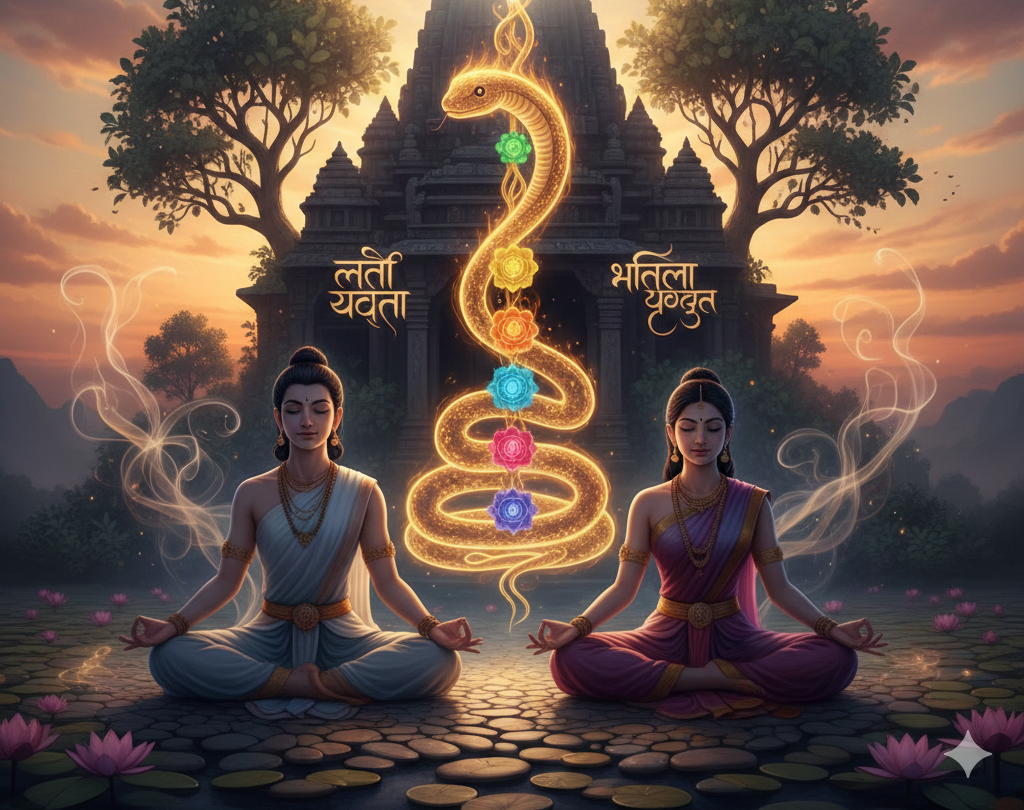
One of the most powerful ideas to emerge from Tantra is Kundalini. In our scriptures, Kundalini is described as a dormant energy resting at the base of the spine. But beyond symbols, it represents potential. Every Indian understands this idea intuitively. We often say, “Uske andar bahut shakti hai.” That inner strength, that untapped power, that is Kundalini.
Through disciplined practice, breath control, and awareness, this energy is said to rise upward through the spine, touching different centers of consciousness known as chakras. Each chakra reflects a stage of human growth and understanding.
- Muladhara speaks of survival and grounding.
- Svadhisthana connects with desire and creativity.
- Manipura builds confidence and inner fire.
- Anahata opens the heart to compassion.
- Vishuddha refines truth and expression.
- Ajna awakens intuition.
- Sahasrara leads to pure awareness.
For an Indian mind, this system does not feel foreign. Our stories, our epics, our daily language are filled with references to inner fire, inner light, and awakening. Tantra simply gave structure to what was already felt.
The Emergence of Hatha Yoga
Between the ninth and fifteenth centuries, another major transformation took place. Hatha Yoga emerged as a practical method to prepare the body for higher states of awareness. Many people today think Hatha Yoga means force or physical strain. But the real meaning is balance.
“Ha” represents the sun, energy, and action.
“Tha” represents the moon, calmness, and rest.
Hatha Yoga is about balancing these two forces within us. This idea reflects the Indian philosophy of harmony. Never too much, never too little. Always the middle path.
Hatha Yoga introduced structured asanas, cleansing practices, breath techniques, mudras, and bandhas. These were not created for appearance or fitness. They were designed to make the body stable, healthy, and resilient. A body that does not distract the mind. A body that can sit still. A body that supports awareness.
This approach made Yoga accessible to more people. You no longer needed to withdraw completely from society. You could work on the body while living in the world.
Matsyendranath and Gorakhnath: Yogis Rooted in the Land
Two names stand tall in the history of Hatha Yoga: Matsyendranath and his disciple Gorakhnath. They belonged to the Nath tradition, which spread across India, Nepal, and Tibet. These yogis were not palace scholars. They lived simply, often among common people.
Gorakhnath, especially, is remembered across villages and towns even today. Temples, folk songs, and local legends still carry his presence. He taught discipline, self-reliance, and fearlessness. His message was clear. Yoga should make a person strong from within, not withdrawn from life.
This reflects a deeply Indian belief. Spirituality should support life, not reject it. A yogi should be steady in the marketplace as much as in meditation.
Why the Body Became Central to Yoga
Earlier traditions emphasized detachment from the body. Tantra and Hatha Yoga taught mastery of the body. This was not a contradiction. It was growth.
Our ancestors realized that liberation does not come from denying existence. It comes from understanding it fully. The body became a bridge between the outer world and inner awareness.
This is why modern Yoga, even when practiced in studios and homes across the world, still carries the imprint of ancient Indian wisdom. Every posture, every breath, every pause is connected to this long journey of exploration.
When we practice Yoga today, knowingly or unknowingly, we continue a tradition shaped by centuries of lived experience. A tradition born in this land, refined by seekers, and preserved through devotion. And that makes Yoga not just a practice, but a shared inheritance of Indian wisdom.