
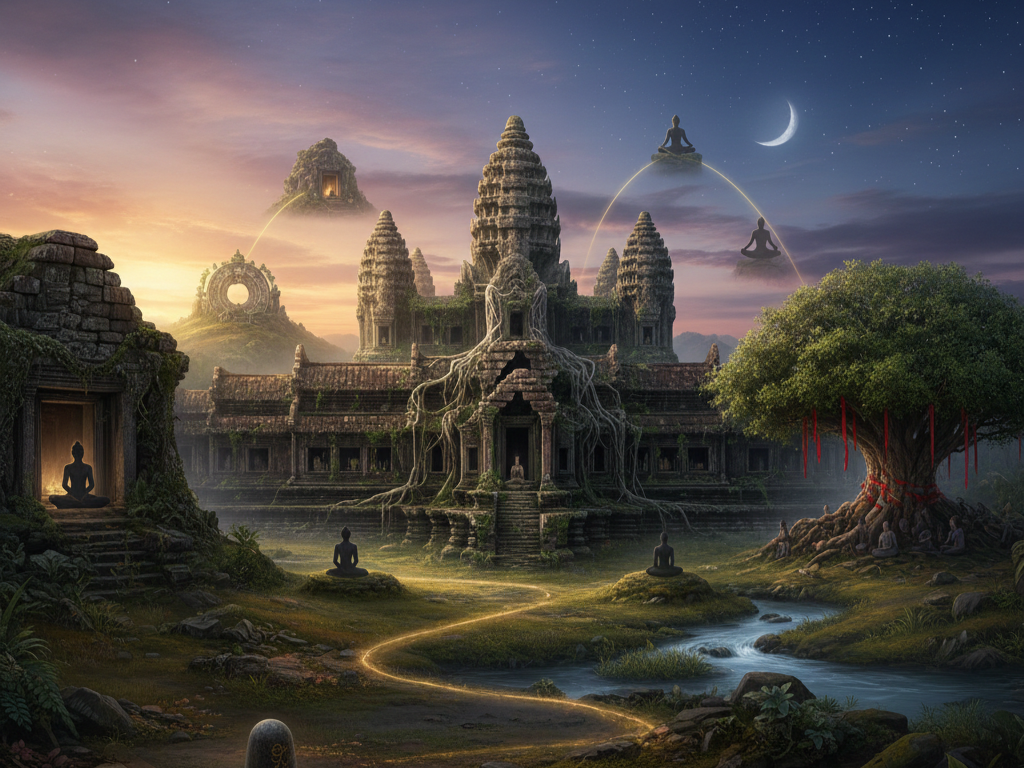
When we look at Yoga today, it feels timeless and untouched. But the truth is, Yoga has survived centuries of change, conflict, and loss. It did not travel in a straight line from the ancient forests to modern studios. It walked a difficult path, sometimes openly, sometimes quietly, often protected by a few dedicated seekers who refused to let it disappear.
In India, knowledge was traditionally passed from teacher to student through direct experience. Yoga was rarely written down in detail. It was lived, practiced, and transmitted through memory and discipline. This made Yoga powerful, but also vulnerable. When social and political structures changed, much of this knowledge risked being lost.
Yet Yoga survived. And it survived because it adapted.
Table of Contents
ToggleYoga in Temples, Caves, and Sacred Spaces
For centuries, Yoga was preserved in temples, caves, forests, and remote monasteries. These were not just places of worship. They were centers of learning and inner exploration. If you visit ancient temple complexes in India, you will notice something interesting. The walls are not only filled with gods and stories. They are filled with yogic postures, meditative figures, and symbolic representations of inner states.
Yogini temples, which existed across central and eastern India, were dedicated to powerful feminine energies. These sites combined Tantra, Yoga, and ritual practice. Many of these temples were later destroyed or abandoned, but their influence remained in oral traditions and local practices.
Caves like those in Ellora and Elephanta were not chosen randomly. They were spaces of silence and stability, perfect for meditation. These locations remind us that Yoga was not meant for performance. It was meant for transformation.
For an Indian, this connection between geography and spirituality feels natural. Rivers, mountains, forests, and caves have always been part of our sacred imagination.
Challenges and Disruptions
As India went through invasions, cultural shifts, and political changes, many traditional systems of learning were disrupted. Large institutions collapsed. Temples were destroyed or repurposed. Gurukuls declined. Yoga, which depended heavily on these systems, moved into the shadows.
But Yoga did not vanish. It went underground.
Yogis became wanderers. Knowledge moved quietly from one generation to another. Practices were simplified. Symbols replaced long explanations. What could not be spoken openly was preserved in stories, songs, and coded rituals.
This period is often overlooked in history books, but it is one of the reasons Yoga still exists today. Survival required flexibility. And Yoga, by its very nature, was adaptable.
Bhakti Movement and Inner Yoga
During the medieval period, the Bhakti movement played a significant role in keeping yogic ideas alive. Saints like Kabir, Mirabai, and others spoke about devotion, inner purity, and surrender. While they did not always use the language of classical Yoga, the essence was the same.
They spoke about controlling desire, observing the mind, dissolving ego, and experiencing unity. Yoga moved from physical discipline to emotional and devotional depth.
This made spiritual practice accessible to ordinary people. You did not need to sit in a cave or master complex techniques. You could live Yoga through love, service, and awareness.
This is again a very Indian quality. Spirituality that meets people where they are.
The Colonial Period and Rediscovery of Yoga
When India came under British rule, many traditional practices were dismissed as superstition. Yoga was often misunderstood or ignored. At the same time, something unexpected happened. Indian thinkers began to look back at their own heritage with fresh eyes.
Figures like Swami Vivekananda presented Yoga to the world not as ritual or mysticism, but as a rational and scientific system of self-development. Yoga gained global attention, especially in the West, through lectures, writings, and cultural exchange.
This period marked a turning point. Yoga moved from secrecy to global curiosity.
Yoga in the Modern World
In the twentieth and twenty-first centuries, Yoga transformed again. It entered schools, hospitals, research centers, and homes. Scientific studies began validating its benefits for mental health, stress reduction, flexibility, and emotional balance.
Today, according to global health studies, millions of people practice Yoga regularly. It is recommended for anxiety, depression, chronic pain, and lifestyle disorders. Yoga is no longer seen only as spiritual practice. It is recognized as a holistic health system.
Yet, this modern success comes with responsibility. When Yoga is separated from its ethical and philosophical roots, it risks becoming shallow. The ancient masters always emphasized balance. Body, breath, mind, and values must move together.
Why This History Matters
Understanding Yoga’s journey helps us practice it with respect. Yoga is not a trend. It is not a quick solution. It is a living tradition that has survived because it addressed real human suffering.
For us in India, Yoga is not borrowed wisdom. It is inherited knowledge. It carries the voices of countless seekers who questioned life, struggled with the mind, and searched for truth.
When we step onto a mat or sit quietly with our breath, we are not starting something new. We are continuing something very old.
And that continuity is what gives Yoga its power even today.